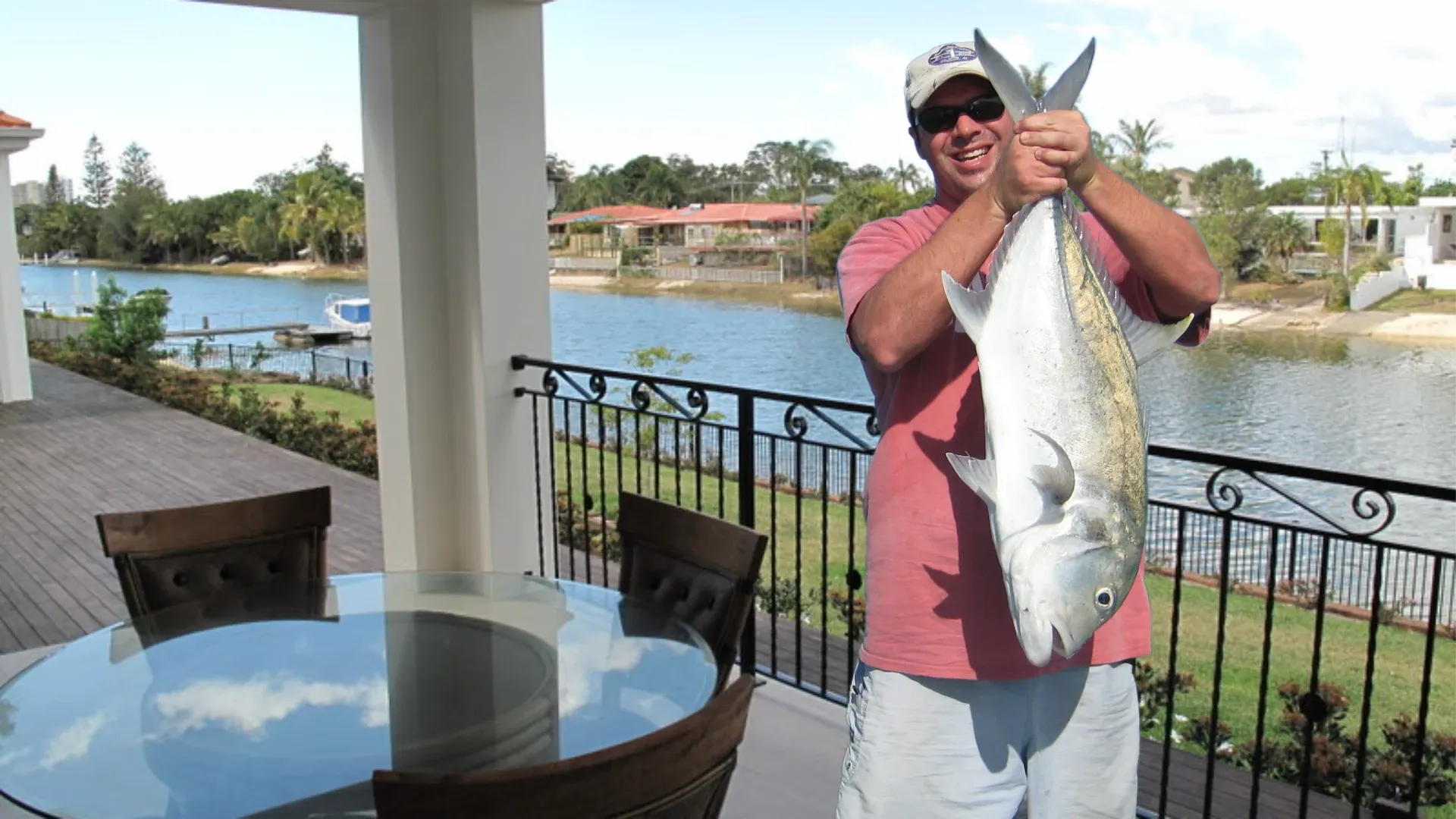
Target Species
Giant Trevally
Gold Coast Canals is one of the best spots for Giant Trevally fishing in QLD, offering accessible urban sportfishing around extensive canal networks, bridges, and deep tidal junctions where aggressive trevally hunt schooling baitfish.
Stretching across hundreds of kilometres of man-made canals and lakes, the Gold Coast canal network stands as one of the most distinctive saltwater environments in Australia. While remote wilderness destinations like Giant Trevally at Exmouth pit anglers against oceanic brutes on coral reefs, the Gold Coast offers an intense, close-quarters street-fishing battleground right in suburban south-east Queensland. Here, juvenile to mid-sized giant trevally (Caranx ignobilis) roam deep suburban canals, scouring retaining walls, hunting beneath streetlights, and ambushing baitschools pinned against concrete culverts.
For local anglers and travelling sportsfishers, giant trevally fishing in the Gold Coast canals provides explosive topwater strikes and blisteringly fast runs mere metres from manicured front lawns and bustling road bridges. The network drains through the Nerang and Coomera rivers into the Broadwater, which opens to the Pacific at the Gold Coast Seaway. This heavy tidal interchange pulls oceanic forage species into deep artificial canals, creating high-protein feeding zones. These predatory powerhouses patrol the shadow lines of private jetties, smash prawns against stone revetments, and use the furious tidal flow around bridge pylons to corner bait.
Navigating this sprawling labyrinth demands sharp observational skills and an understanding of urban tidal hydrology. You must read human-made structure just as carefully as an offshore skipper reads coral bombies. In this detailed guide, you will uncover the seasonal movement patterns of canal GTs, master specific tackle configurations capable of extracting fish from sharp oyster leases, pinpoint productive weir gates and bridge corners, and explore the exact retrieval cadences required to trigger violent strikes. Whether you are walking public footpaths at daybreak or casting soft plastics from a kayak under pontoon lights, learning this system unlocks some of the finest light-tackle sport available in Australian estuarine waters. If you are starting fresh with light sport tackle, review our fishing basics guide before tackling these street fighters.
Getting There
Giant Trevally
Caranx ignobilis
Always check current NSW DPI regulations before fishing. Bag and size limits may change.
Understanding Gold Coast Canals: Location Intelligence
Giant Trevally hold in deep canal junctions, beneath lit road bridges, along rock revetment walls, and near freshwater weir outflows where tidal current concentrates baitfish against man-made structure.
The Gold Coast canal system is not a natural river estuary. It is a vast, interconnected grid of deep dredge-cut canals, retention basins, residential lakes, and weir-controlled freshwater margins. To locate giant trevally consistently, you must look at how saltwater moves through this man-made maze. Massive tidal pulses push through the Gold Coast Seaway, flooding into the Nerang River and circulating throughout branches like the Isle of Capri, Monaco Street, and Clear Island Waters. This continuous tidal flush keeps the water clean, saline, and thermally stable throughout the year, which suits tropical carangids perfectly.
Location Essentials
Water depth varies dramatically across the system. Standard residential canals sit between 2 and 4 metres deep at low tide, while mainline river channels, canal junctions, and dredged holes drop down to 8 to 12 metres. Giant trevally use these deeper depressions as staging zones during slack water, rising into the shallows as the tide gathers pace. Key environmental features to identify include:
- Canal Junctions and Intersections: Points where two or three canal arms merge create turbulent hydrodynamics. As opposing currents collide, water speeds slow along the seam lines, disorienting passing schools of herring and poddy mullet. GTs patrol these junctions, holding in the deeper scour holes before rising into mid-water to ambush prey.
- Bridge Pylons and Shadow Boundaries: Heavy road bridges, such as those along Bermuda Street, Bundall Road, and the Gold Coast Highway, support dozens of thick concrete pylons. These structures serve two distinct purposes. During daylight hours, the pylons break strong tidal flow, providing resting eddies directly downstream where trevally conserve energy. At night, overhead street lighting creates hard shadow edges on the water surface. Prawns and baitfish gather in the illuminated zones, and trevally make high-speed sweeps along the dark perimeter.
- Revetment Walls and Rocky Drop-Offs: The banks of the canals are lined with rock revetment walls and vertical concrete bulkheads to combat erosion. These surfaces host thick growths of oysters, barnacles, and weed, establishing an ecosystem for crabs, juvenile fish, and glass prawns. Incoming tides submerge these rocky ledges, and GTs run parallel to the walls just centimetres out from the stone, smashing bait pinned against the rock face.
- Weirs and Culverts: The Bond University weir, the upper limit of the Nerang tidal system, is prime ambush territory. Lake Orr, Varsity Lakes and the other lakes behind it drain into the tidal canals here, right beside the council’s Pizzey Park fishing platform. When localised rain triggers a freshwater spillover, nutrients wash down, sweeping small baitfish, terrestrial insects, and freshwater invertebrates straight into the saltwater canal arms. Trevally gather below the spillways in numbers, competing aggressively for anything tumbling through the foaming current.
- Private Pontoons and Boat Hulls: While requiring courteous angling around private property, floating pontoons generate broad overhead shade canopies. In clear, sunny conditions, trevally suspend directly beneath boat hulls and pontoon floats, waiting for schools of hardyheads or small garfish to pass.
Gold Coast Canals
-28.0100, 153.4100
The dynamic nature of the canal waterways means water clarity shifts according to tidal state and rainfall. During dry spells, high oceanic tides bring crystal-clear water into the upper reaches, demanding long leaders and precise presentations. Conversely, summer thunderstorms wash silty runoff through urban drains, concentrating predatory action along visible water colour changes where dirty surface water meets cleaner tidal push. The same canals hold mangrove jack and barramundi, and our giant trevally species page compares this fishery with the reef GTs of Exmouth. Understanding how trevally behave around human-made obstacles allows you to bypass miles of dead water and focus entirely on high-percentage intercept zones.
Where Should You Stay for a Canal GT Trip?
Ingenia Holidays Kingscliff is about 40 minutes down the M1 from Broadbeach Waters, close enough to fish the dawn tide in the canals and spend the rest of the day on the Tweed. Stay 4 nights and save 20%.
When Is the Best Time to Fish for Giant Trevally at Gold Coast Canals?
The best time to target Giant Trevally in the Gold Coast Canals is during low-light periods at dawn and dusk, especially when aligned with the final two hours of the run-in tide or the start of the ebb. Night sessions around lighted bridges on an outgoing tide also yield exceptional surface feeding activity as prawns flush out of the upper lakes.
Tidal movement governs almost every predatory movement within the Gold Coast canal network. Giant Trevally, known locally as GTs, rely heavily on moving water to disorient baitfish and push schools of glass prawns, whitebait, and juvenile mullet into vulnerable positions. The final two hours of the incoming tide bring clean, oxygenated ocean water deep into systems like Sovereign Islands, Broadbeach Waters, and Runaway Bay. As clean water pushes into murky residential waterways, a distinct clarity line forms. Giant Trevally patrol these current boundaries relentlessly, striking unsuspecting bait swept across the transition zone.
Tide Times
Optimal Tide
Final two hours of incoming tide through the first hour of outgoing tide
Tide movement is critical for fish activity. Most species feed actively during tide changes, especially the run-in (incoming) tide.
Detailed hourly tide charts
Official tide predictions
7-day tide calendar
Tide Guide
Best for most species. Fish move in to feed as water rises.
Good for ambush predators. Baitfish get swept out.
Slower bite. Fish less active during slack water.
New/full moon. Bigger tidal range, more fish movement.
Moon Phase & Solunar
Moon phases influence fish feeding behavior. New and full moons create spring tides with stronger currents and increased fish activity.
Best Phases
- New Moon: Peak feeding activity, spring tides, excellent fishing
- Full Moon: Strong tides, night feeding, great for nocturnal species
- 3 Days Either Side: Extended peak period for maximum results
Major/Minor Periods
- Major Periods: Moon overhead/underfoot (2-3 hours)
- Minor Periods: Moon rise/set (1-2 hours)
- Best Times: Major period + dawn/dusk = explosive action
Dawn and dusk trigger acute feeding responses. The hour spanning first light allows visual hunters like GTs to spot schools of bait dimpling the surface while remaining partly concealed in the gloom below canal pontoons. During dusk, baitfish that spent the day sheltering underneath boat hulls drift out into open water, sparking sudden surface blitzes that reverberate across the quiet canals. When low-light timing coincides with a high tide turn, conditions become prime for aggressive topwater action.
Night fishing produces some of the most exciting land-based and small-boat action in the entire canal network. Artificial lighting transforms bridges, private jetties, and riverside boardwalks into food factories. Overhead street lamps on structures like the Nerang River bridges and the road bridges across Broadbeach Waters cast sharp shadow lines across the water. Shrimp and small baitfish gather under the illuminated pools, while Giant Trevally hold deep in the dark water on the down-current side. As bait drifts past the shadow line, GTs launch upward in explosive ambush strikes.
Weather Conditions
Check current conditions before heading out. Wind, swell, and barometric pressure significantly affect fish behavior.
Official forecasts, warnings & radar
Hourly wind speed & direction
Swell height, period & direction
Tidal volume dictates your angling approach throughout the canal system. Neap tides often cause canal waters to clear out excessively, making trevally wary and skittish during broad daylight. Spring tides create ripping currents around narrow bridge pylons and canal choke points, concentrating bait and triggering prolonged feeding frenzies. However, severe rain events can deposit a heavy layer of dirty freshwater on the surface. When that happens, look for GTs holding deep in the saltier, denser layer along bottom drop-offs and bridge footings where the salinity remains stable.
Giant Trevally Seasonal Calendar
Capitalise on Weir Discharges After Rain
Whenever sudden rain sends the lakes behind the Bond University weir spilling into the tidal canals, fish the turbulence immediately down-current. GTs patrol the froth line to smash stunned freshwater baitfish swept over the weir wall.
What Tackle Do You Need for Giant Trevally at Gold Coast Canals?
For canal Giant Trevally, you need a responsive 7-foot medium-heavy spin rod rated at 4 to 8 kilograms paired with a high-speed 3000 to 4000 series spin reel loaded with 15 to 20-pound braided mainline. Connect this to a 20 to 30-pound fluorocarbon leader to handle rough pontoon corners and oyster encrusted pylons.
Canal GT fishing demands a delicate compromise between casting finesse and brutal stopping power. While open-ocean trevally allow you to run heavy offshore gear (our Gold Coast kingfish guide covers that end of the scale), canal fish require pinpoint casts with modest lures into tight pockets between luxury yachts and timber jetty poles. A stiff 7-foot graphite spin rod provides the casting accuracy needed to drop a lure centimetres from a pontoon roller while maintaining enough lower-blank backbone to haul a hooked fish away from sharp mooring ropes. If you need a refresher on matching gear, explore our fishing tackle basics guide for complete setups.
Your reel choice must balance line retrieval speed and drag reliability. Giant Trevally often hit lures moving at high speed, requiring high-gear spin reels with retrieve rates above 85 centimetres per handle turn. When a 60-centimetre canal GT realises it is hooked, its immediate instinct is to dive underneath the nearest floating dock or wrap around a concrete bridge support. A smooth carbon fibre drag system rated to deliver at least 7 to 9 kilograms of continuous, jerk-free pressure is critical. Reels with sloppy drag systems will result in pulled hooks or immediate break-offs against sharp structure.
Braided line is non-negotiable in this urban environment. An eight-carrier PE braid rated between 15 and 20 pounds provides thin diameter for long casting, zero stretch for setting hooks instantly at distance, and high sensitivity to detect soft taps on the drop. Join your braid directly to your fluorocarbon using a low-profile connection knot such as the FG knot or a streamlined double uni knot. Master these setups by checking our guide to fishing knots.
Leader selection can make or break your session. Clear canal water demands leaders that are virtually invisible, yet tough enough to withstand razor-sharp rock walls and barnacle-encrusted piles. Fluorocarbon leaders between 20 and 30-pound breaking strain strike the right balance. On calm days in broad daylight, drop down to 16-pound leader to coax strikes from wary fish. When working gnarly bridge footings at night, step up to 30-pound leader to provide insurance against heavy structure abrasion.
Complete Tackle Specifications
| Component | Specification |
|---|---|
| Rod | 7ft 0in fast-action graphite spin, 4-8kg rating |
| Reel | 3000-4000 high-speed spin reel (6.0:1 or higher gear ratio) |
| Main Line | 15-20lb eight-carrier PE braided line |
| Leader | 20-30lb fluorocarbon, 2 to 3 metres in length |
| Lures | 65-95mm walk-the-dog stickbaits, 3-4 inch paddle tail plastics |
| Jigheads | 1/4oz to 1/2oz forged heavy-wire hooks, size 2/0 to 3/0 |
| Bait Hooks | Size 1/0 to 3/0 wide gape circle or heavy-wire bait holder |
| Terminal Hardware | Size 8 rolling barrel swivel or solid welded ring |
How Do You Rig for Giant Trevally?
The most effective rig for canal Giant Trevally is an unweighted or lightly weighted live bait rig using a free-sliding sinker directly above a fluorocarbon trace, or an unweighted setup with a circle hook pinned through the nose of a lively baitfish. This configuration allows natural movement while preventing the fish from detecting unnatural resistance.
Rigging for trevally in enclosed canals requires keeping hardware to an absolute minimum. Bulky swivels, heavy sinkers, and wire traces stand out in clear canal water and cause GTs to inspect your presentation and turn away. Instead, streamlined running sinker rigs and unweighted live bait setups allow baits like herring or poddy mullet to swim uninhibited near pontoon edges. Learn how these configurations compare by reading through our fishing rigs explained guide.
When presenting live bait near bridge pylons where current runs hard, use just enough weight to hold the bait midway down the water column without pinning it hard to the seabed. A small barrel or ball sinker running freely on the main braid above a tiny barrel swivel protects your mainline from abrasion while letting bait swim in wide circles. The following seven-step guide outlines how to build a durable, tangle-resistant running sinker rig designed to survive intense pressure around urban canal pylons.
Building the Canal Trevally Running Sinker Rig
- 1
Thread the Running Sinker
Slide a size 1 or size 2 ball sinker onto your braided mainline, ensuring the sinker bore has no burrs that could fray the braid.
- 2
Add a Buffer Bead
Thread a soft 4mm rubber buffer bead directly behind the sinker to protect your connecting knot from repeated impacts under line pressure.
- 3
Tie the Connection Swivel
Secure a size 8 heavy-duty black nickel barrel swivel to the end of your mainline braid using a lubricated Palomar knot or Uni knot.
- 4
Cut Fluorocarbon Leader
Measure out approximately 1.5 to 2 metres of premium 20 to 25-pound fluorocarbon leader material.
- 5
Join Leader to Swivel
Tie one end of the fluorocarbon trace to the open ring of the barrel swivel using a five-turn Uni knot, pulling it firmly tight.
- 6
Snell or Tie the Circle Hook
Fasten a size 2/0 heavy-wire circle hook to the tag end of the leader using a snell knot or a non-slip mono loop knot to maximise bait mobility.
- 7
Test Connection Integrity
Pull firmly on the rig between your hands with leather gloves or a rag to seat all knots and guarantee zero slippage under drag pressure.
If you fish artificial presentations instead of bait, your rig setup simplifies dramatically. Tie your 20-pound fluorocarbon leader directly to the braided mainline using an FG knot, keeping the leader around 2.5 metres long. At the terminal end, tie a non-slip mono loop knot directly through the eyelet of your lure or jighead. The open loop lets walking stickbaits swing freely through their full side-to-side cadence and gives soft plastics unrestricted flutter during the drop. Avoid snap swivels whenever possible; small GTs are notorious for bending open lightweight clips during sudden direction changes beneath canal docks.
What Bait Works Best for Giant Trevally?
Live silver herring and live poddy mullet are the most effective baits for canal Giant Trevally, closely followed by freshly caught live glass prawns and small yellowtail scad. Live presentations that kick and swim actively entice violent reaction strikes from cruising canal predators far better than dead bait.
Giant Trevally are opportunistic apex predators within the Gold Coast waterways, but they show a heavy preference for prey they can pursue and engulf in motion. While GTs will scavenge a fresh strip of oily tuna or pilchard resting on the bottom of a canal bend, nothing compares to the strike trigger produced by a terrified, kicking live bait. A healthy herring struggling against the current under a pontoon sends vibrations through the water that a hunting trevally detects from dozens of metres away. Check out our complete fishing bait guide for deeper tips on keeping various species alive.
Live herring reign supreme across the central Gold Coast canal systems. Schools of herring hold under bridge spans and public jetties in the Isle of Capri and around Chevron Island. Catching them on multi-hook bait jigs requires minimal effort before your main session. Pinning a live herring through the upper shoulder behind the head allows it to swim forward naturally into the tidal flow. When drifted along rock walls or underneath floating docks, a lively herring rarely lasts long before being engulfed.
Poddy mullet offer exceptional durability and stay lively far longer than delicate herring. You can gather poddy mullet from shallow sandy canal bays using a clear acrylic bait trap baited with bread crusts. Their hardy nature makes them ideal for casting into heavy current around weir spillways and bridge pylons. When pinned lightly through the tough cartilage of their upper lip, poddy mullet attempt to dive straight for bottom structure, swimming right into the ambush zone of holding Giant Trevally.
Bait Performance Analysis
| Live Herring | Live Poddy Mullet | Live Glass Prawns | |
|---|---|---|---|
| Effectiveness Rating | Outstanding (9.5/10) | Exceptional (9/10) | Very High (8.5/10) |
| Durability on Hook | Moderate | Very High | Low |
| Scent Dispersion | High vibration | Moderate | Exceptional sweet scent |
| Availability | Abundant around bridges | Easy to catch in shallows | Seasonal (Summer/Autumn) |
| Best Use Conditions | Daylight pontoons and current edges | Heavy tidal flow and turbulent weir gates | Night sessions around illuminated bridge shadow lines |
Hook Placement Matters
When fishing live bait in running canal tides, always hook your poddy mullet or herring through the hard nostrils or upper jaw. Hooking them through the back causes them to spin unnaturally in the current, drowning the bait and repelling cruising trevally.
During the late summer and autumn months, live glass prawns become the premier bait choice around illuminated canal bridges. Prawns flush out of the upper lakes on dark, receding tides, gathering near street lamps and underwater dock lights. Hooking a translucent live prawn through the tail horn using a fine-wire size 1 hook and drifting it unweighted through the light line will fool the most educated canal trevally in the system. For more advice on pairing natural baits with variable currents, explore our fishing techniques guide.
How Do You Catch Giant Trevally at Gold Coast Canals?
To catch Giant Trevally in the Gold Coast canals, target high-current ambush points like bridge pylons, pontoon corners, and rock wall eddies using precise casting, fast retrieves, and immediate pressure to steer fish away from structure.
Landing a canal GT demands a mix of pinpoint accuracy, rapid reflexes, and calm control under pressure. These fish do not give you a second chance. The moment a trevally inhales a lure or bait around heavy residential infrastructure, its immediate instinct is to dive straight back into the sharpest oyster-encrusted structure available.
Casting Strategy and Bait Placement
Accuracy trumps distance every single time in canal systems. When working pontoon lines, your lure or bait needs to land within inches of the flotation blocks. GTs use the dark shade beneath pontoons to stalk bait schools passing in the tidal flow. Cast upstream of the structure and allow your presentation to swing naturally past the ambush corner on the current seam.
If you are casting lures, begin your retrieve the split second the lure touches the water. When surface poppers are on the menu, use sharp, aggressive downward sweeps of the rod tip to create loud bloops, followed by very brief pauses of no more than half a second. A pause that is too long gives a wary canal trevally time to inspect and reject the artificial presentation. If you are throwing soft plastics, cast past the target structure, let the jig head sink through the water column for three to four seconds, and retrieve with violent double-twitches interspersed with rapid winding.
For bait anglers, placement requires reading the current seams. Anchor or position your boat or kayak up-current from a canal junction or bridge pylon. Cast your unweighted or lightly weighted live bait directly into the eddy line where the fast water meets slack water. Allow the bait to drift naturally along the edge of the pylon without tension on the spool until it reaches the strike zone. If you are fishing from a public park or riverbank, cast slightly up-tide from rock wall points and let the running tide sweep your bait across the front of the rocks. You can discover more advanced reading-water methods in our detailed fishing techniques guide.
Bite Detection and Hookset
Strikes from canal Giant Trevally are rarely subtle. On surface lures, the take is visual and explosive, accompanied by a loud crack and a spray of displaced water. The most common mistake anglers make on a surface strike is striking prematurely. When you see the boil, keep winding until you feel the heavy weight of the fish bending your rod blank. Once the rod loads, set the hook with two firm, sharp upward strikes to drive the barbs past the fish’s tough, bony jaw.
When bait fishing with live herring or mullet on circle hooks, bite detection involves watching your line tighten at lightning speed. Never strike with a circle hook. Simply drop the rod tip toward the fish, let the line pull tight, and turn the reel handle smoothly against the drag until the bend of the hook naturally rolls into the corner of the jaw. If you are using conventional suicide hooks, let the fish run for two to three seconds as the rod tip dips, then set the hook decisively with a firm sweep of your arms.
Fighting and Landing
The initial run of a canal GT is where the battle is won or lost. Because these fish run hard for the nearest pylons, pontoons, or submerged chains, you must lock down and turn their heads within the first five seconds. Set your reel drag to approximately one-third of your line class before casting, but be prepared to cup the spool with your palm during that initial burst to apply emergency stopping power.
Keep your rod angle low to the water. A high rod angle pulls the fish upward toward structure edges and puts severe stress on the blank, whereas a low rod angle applies side-strain that forces the fish off balance and turns its head toward open water. Keep constant pressure on the fish; never give it slack line, as a GT will instantly use slack to throw the hooks or find an oyster ledge to slice your leader.
Once the fish is out in the middle of the canal channel, it will settle into a stubborn, circling dogfight, using its deep, flat flank to plane against the current. Pump and wind smoothly, gaining line whenever the fish pauses its run. Keep your landing net in the water ahead of time. Lead the exhausted fish head-first into a large, knotless rubber landing net. Avoid lifting a heavy trevally out of the water by the leader, as the sudden thrashing will snap the trace or pull the hooks.
What Are the Rules for Fishing at Gold Coast Canals?
In Queensland tidal waters, giant trevally fall under the combined trevally limit of 20 in total of all trevally species, with no minimum legal size.
Queensland has no minimum legal length for trevally, so responsible handling is what protects the local population. Limits checked November 2026 against the Queensland Government’s size and possession limits in tidal waters. Rules change, so check them, or the Qld Fishing 2.0 app, before each trip, and see our regulations guide for how the states compare.
Critical Canal Hazards and Safety Considerations
The Gold Coast canal system contains specific environmental hazards that demand constant awareness:
- Bull Sharks: Bull sharks are permanent residents throughout the Nerang River, Coomera River, and connecting residential canals. Never wade into canal water, avoid swimming under any circumstances, and never wash your hands or clean fish directly at the water’s edge.
- Submerged Hazards: Private boat mooring cables, floating pontoon chains, jagged oyster beds, and discarded rubbish litter canal banks. Wear puncture-resistant, hard-soled footwear if walking shorelines or rock walls.
- Venomous Marine Life: Muddy canal flats and rock groynes house stingrays, stonefish, and happy moments (black rabbitfish). Shuffle your feet if stepping in soft shallows and carry hot water to treat potential stings.
- Vessel Traffic: High-speed leisure craft and jet skis create dangerous wakes in narrow channels. If fishing from a kayak or small tinny, wear a high-visibility lifejacket (PFD), keep a working air horn or whistle ready, and check the Gold Coast Waterways Authority speed limits and no-wash zones.
- Emergency Contact: In an emergency, call Triple Zero (000). Report illegal fishing to the 24-hour Fishwatch hotline on 1800 017 116.
To ensure these exceptional sportfish remain plentiful in urban Gold Coast waters, adopt the following catch-and-release and conservation practices:
- Practise Catch and Release: Large canal GTs carry high sport value but poor eating qualities due to their tough, dry flesh. Release all adult trevally to let them continue breeding and hunting within the waterway.
- Support the Fish Horizontally: Giant Trevally have heavy internal organs that suffer severe damage if held vertically by the jaw. Always support the belly horizontally with one wet hand while gripping the wrist of the tail with the other.
- Use Barbless or Single Hooks: Crushing the barbs on trebles or replacing factory treble hooks with inline single hooks drastically reduces tissue damage and shortens unhooking time on the brag mat.
- Limit Air Exposure: Keep the fish submerged in the net until your camera is ready. Minimise out-of-water exposure to less than 30 seconds to ensure a fast recovery.
- Revive Before Release: In brackish canal systems, oxygen levels can be lower than in the open ocean. Hold the fish gently facing into the current until it kicks strongly out of your grip.
- Review Safety Fundamentals: Read our guide on fishing safety for complete advice on handling sharp spines, teeth, and sudden watercraft incidents.
Your Questions About Giant Trevally Fishing at Gold Coast Canals
What is the best time to fish at Gold Coast Canals?
The best time to fish for Giant Trevally in the Gold Coast canals is during low-light periods at dawn and dusk, particularly when coinciding with the top half of a making run-in tide.
These peak fishing hours trigger aggressive feeding behaviour as low light gives predatory trevally a distinct visual advantage over baitfish. When deciding when to fish, check the local tide tables to line up first light with an incoming tide, which pushes clean saltwater and schools of whitebait and herring deep into the canal branches.
Is Gold Coast Canals suitable for beginners?
Yes, the Gold Coast canals offer accessible spots suitable for beginners, though landing a large Giant Trevally on light gear requires solid angling skills.
Novice anglers can find beginner-friendly access points along public council parklands like Evandale Parklands, the Pizzey Park fishing platform, and the bridges near Broadbeach Waters. These locations provide flat grassed banks and safe platforms. Starting with basic bait fishing rigs targeting juvenile fish in the 30cm to 45cm class is the ideal way to build confidence before tackling trophy GTs.
Do I need a boat to fish at Gold Coast Canals?
No, you do not need a boat because extensive land-based fishing access exists across council reserves, public jetties, bridge paths, and park foreshores throughout the canal estate.
While a kayak or small boat gives you access to private pontoon edges, shore fishing produces spectacular catches if you focus on accessible structure. Public road bridges, culverts, weir spillways, and park rock walls all offer outstanding shore-based casting opportunities where you can intercept cruising pelagics.
Where are the best specific spots at Gold Coast Canals?
The premier spots include the Nerang River bridges at Surfers Paradise, the Bond University weir outflow beside the Pizzey Park fishing platform, and the rock wall corners of the Broadwater entrance.
These prime fishing marks consistently concentrate baitfish due to heavy water exchange and underwater drop-offs. Other notable canal hot spots include the Isle of Capri bridges and the junction channels around Sanctuary Cove, where rapid tidal funnels disorient bait and trigger feeding frenzies.
What size Giant Trevally can I expect?
Most canal Giant Trevally measure between 35cm and 60cm, but fish exceeding 75cm to 90cm enter the system on large seasonal tides.
The average catch size in the inner canal subdivisions consists of juvenile and sub-adult fish that provide electrifying sport on light spin tackle. Bigger fish occasionally patrol the deep holes near the river mouths and Seaway channels during peak autumn runs.
Is there parking available at Gold Coast Canals?
Ample free street parking and dedicated council park lots are available adjacent to most public canal reserves across the Gold Coast.
When planning how to get there, look for public reserves such as Evandale Parklands, Pizzey Park, or shoreline road reserves in Broadbeach Waters and Mermaid Waters. Most of these sites feature convenient vehicle access within short walking distance of the water’s edge, making gear transport simple.
Can I fish at night at Gold Coast Canals?
Yes, night fishing is highly productive in the canals, particularly around lighted bridges and illuminated private jetties that attract glass prawns and bait schools.
Targeting GTs after dark requires a stealthy approach. Bridge streetlights cast distinct shadow lines across the water, creating ambush runways where trevally wait on the run-out tide. Top night fishing tips include casting small lures or live prawns along the dark edge of the light shadow and working them with an erratic twitch.
Where can I buy bait near Gold Coast Canals?
You can buy fresh and frozen bait at tackle shops across the Gold Coast, including around Southport, Labrador and Bundall.
These local tackle stores nearby stock quality frozen pilchards, squid, and local prawns, along with live worms and yabbies. Many 24-hour service stations along the Gold Coast Highway and Nerang-Broadbeach Road also keep emergency supplies of frozen bait and ice for dawn or late-night outings.
What are the current bag and size limits?
In Queensland, giant trevally fall under the combined limit of 20 in total of all trevally species, with no minimum legal size.
Even though these legal limits allow taking multiple fish, sports anglers are strongly encouraged to limit their catch rather than catch their limit. Releasing canal GTs preserves the sport fishery and protects local predator stocks in these confined urban waterways.
Is Gold Coast Canals family-friendly for fishing?
Yes, the canals offer plenty of family-friendly parks with grassy banks, safety fences, playgrounds, public toilets, and shaded picnic tables.
For safe kids fishing, head to spots like Evandale Parklands beside HOTA or the Pizzey Park fishing platform at Mermaid Waters. These locations provide flat, paved walking tracks, fenced areas, and wide grassy verges set well back from sharp drop-offs, allowing young anglers to fish safely for small trevally and bream.
What should I bring for a fishing session?
Your essential gear checklist should include a 7ft spin rod, 20lb leader, a landing net, polarised sunglasses, hook removers, sun protection, and a headlamp for night trips.
An effective canal fishing checklist also needs a small tackle tray with an assortment of soft plastics, walk-the-dog surface lures, and pre-tied traces. Always pack plenty of fresh water, insect repellent for sandflies at twilight, and a pair of long-nosed pliers to safely unhook thrashing trevally without risking your fingers.
How crowded does Gold Coast Canals get?
Canal shores are generally uncrowded on weekdays, but boat and jet ski traffic increases dramatically on weekends and during school holidays.
To discover quiet fishing times and avoid heavy watercraft traffic, plan your sessions for mid-week mornings or fish late at night when pleasure boats are docked. If fishing on weekends, the best times to avoid crowds are between 4:30 AM and 7:30 AM before recreational boaters take to the water.
Latest Fishing Reports
Stay updated with the latest catches, conditions, and hot tips from Gold Coast Canals. Check these sources for recent reports filtered by location and species.
Fishraider
Community fishing reports and catch logs
Fishing World
Professional fishing reports and news
Tackle World
Local tackle shop reports and tips
NSW DPI
Official recreational fishing reports
Fishingmonthly
Monthly fishing magazine and reports
Hooked Up
Video fishing reports and tips
Pro Tip: Filter Reports
When browsing reports, search for "Gold Coast Canals" or nearby landmarks. Look for reports from the last 7-14 days for the most relevant information. Pay attention to tide times, weather conditions, and successful techniques mentioned.
Share Your Catch
Caught something at Gold Coast Canals? Share your success with the community! Upload your catch photos and reports to help other anglers.
Fishing regulations, bag limits, and marine boundaries change periodically across Queensland. Always check the latest rules before you wet a line. Explore more fishing spots in the area, discover other target species in our complete species guides, or brush up on fundamental techniques with our fishing basics guide.
Quick Info
- Location
- Gold Coast Canals
- Coordinates
- -28.0100, 153.4100
- Difficulty
- intermediate
- Target Species
- Giant Trevally
Conditions
Check local weather and tide conditions before heading out.