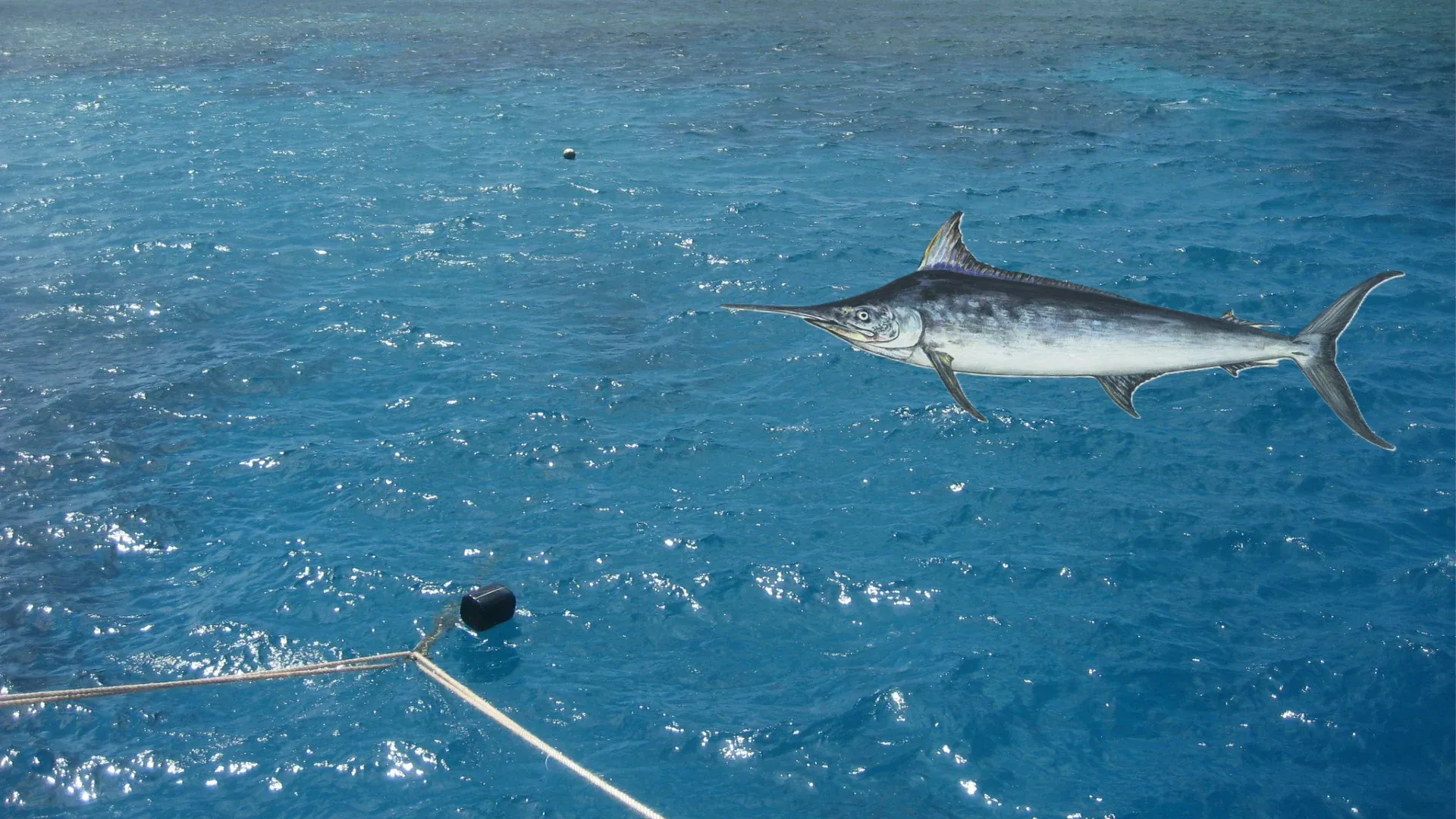
Target Species
Black Marlin
Ribbon Reef Central is one of the best spots for Black Marlin fishing in QLD, offering direct access to the continental shelf drop-off and consistent encounters with legendary grander-class gamefish.
Running along the outer edge of the Great Barrier Reef north of Cairns, off Cooktown and Lizard Island, the Ribbon Reef system forms a natural defensive wall against the vast expanse of the Coral Sea. Black marlin fishing at Ribbon Reef Central holds an almost mythic status among game fishers across the globe. Here, the turquoise shallows of the coral reef terminate abruptly into an abyssal trench, where rich pelagic currents funnel enormous schools of scads, mackerel, and tuna straight into the strike zone of apex billfish.
Targeting giant black marlin in this remote marine wilderness requires thorough preparation, calculated bait rigging, and an appreciation for raw oceanic power. Anglers visiting Ribbon Reef Central are not merely chasing table fish or light tackle sport. They are preparing for multi-hour battles against ocean predators that frequently exceed 500 pounds, with authentic shots at the fabled thousand-pound grander. Whether you are stepping onto a dedicated custom game boat out of Cooktown or venturing out on an extended liveaboard expedition, understanding the distinct underwater terrain and feeding cycles of this reef corridor is essential.
In this guide, you will learn the exact geography that drives bait concentrations at the central ribbons, the seasonal migration movements that bring huge female marlin onto the reef edge, the specialized heavy tackle setups required to manage blistering runs, and the precise trolling strategies used by veteran skippers to raise fish from the depths. Before you run your teasers out past the reef crest, consult our fishing basics guide and review critical offshore protocols in our fishing safety guide.
Getting There
Black Marlin
Istiompax indica
Always check current NSW DPI regulations before fishing. Bag and size limits may change.
Understanding Ribbon Reef Central: Location Intelligence
Ribbon Reef Central comprises the middle segments of the elongate reef chain, primarily encompassing Ribbon Reef Number 4, Number 5, Number 6, and Number 7. These narrow, linear barrier reefs sit roughly thirty to forty nautical miles off the tropical north Queensland coastline, positioned directly on the boundary where Australia’s continental shelf plummets into the Coral Sea basin. The transition is startling: within a few hundred metres of the exposed coral crest, the ocean floor drops from thirty metres over the outer reef wall down past five hundred metres, before plunging beyond a thousand metres into deep cobalt water.
The physical geography of the central ribbons functions as an immense oceanographic funnel. Strong equatorial currents flowing through the Coral Sea collide with this vertical limestone barricade, generating powerful upwellings that bring nutrient-dense, cooler water up from the depths into the sunlit photic zone. This upwelling supercharges the local marine food chain. Phytoplankton blooms attract dense aggregations of baitfish, including two-pound yellowtail scad, fusiliers, rainbow runner, Spanish mackerel, and large schools of skipjack and juvenile yellowfin tuna.
Black marlin congregate along the outer face of Ribbon Reef Central to capitalise on these bait concentrations. The prevailing South-East trade winds drive surface water firmly against the eastern ledge of the reefs, compressing schools of bait tight against the drop-off. The numerous passes and cuts between the ribbons, such as the passage between Reef 5 and Reef 6, create dynamic current rips on changing tides. As falling tides draw warm, lagoon-filtered water out through the openings, predatory pelagics patrol the plume edges where clear ocean water meets nutrient-rich lagoon discharge.
Navigating and fishing this stretch demands strict attention to bottom structure and sea conditions. The reef crest provides a barrier that dampens ocean swells on its western lee side, creating protected anchorages for game boats overnighting in the calm lagoon waters. However, once you cross through the reef passes to the exposed seaward side, you are immediately exposed to open ocean conditions, large rolling swells, and fierce ocean chop. Successful crews focus their trolling efforts along the 50-fathom to 150-fathom contour lines, constantly searching for temperature breaks, diving sea birds, and tightly packed bait balls marked on the sounder. For other blue-water targets, compare our NSW yellowfin tuna and Gold Coast kingfish guides, or browse the full fishing spots directory.
Location Essentials
Ribbon Reef Central
-15.3800, 145.7900
When Is the Best Time to Fish for Black Marlin at Ribbon Reef Central?
The best time to target Black Marlin at Ribbon Reef Central is during the spring season from September through December, with daily bite windows peaking sharply between 1:00 pm and sunset on the incoming tide.
Understanding the daily rhythm out wide on the Great Barrier Reef saves hours of wasted fuel and energy. Unlike coastal estuaries or inshore reef grounds where dawn and dusk rule supreme, heavy-tackle marlin crews along the Ribbons run on a distinct daily pattern. The morning hours from 7:00 am through 11:00 am are usually spent inside the reef flat or around the passes bait fishing. Anglers fill the live-wells and brine-tanks with fresh scads, rainbow runner, and juvenile tuna while the outer shelf is bathed in flat morning light. Black marlin rarely feed aggressively out deep during the first hours of daylight because the thermocline sits deep and pelagic bait schools stay tightly balled below the shelf drop-off.
The real action ignites shortly after lunch. From roughly 1:00 pm until the sun dips behind the mainland range, the outer drop-off comes alive. As the sun angle tilts into the afternoon, bait schools disperse upward toward the surface, and giant black marlin move up from the abyssal depths of the Coral Sea to hunt along the hard coral edges. An afternoon bite window between 2:00 pm and 5:00 pm produces the vast majority of strikes across the fleet. Trolling past 5:30 pm into twilight often yields heart-stopping encounters with the largest fish of the season, as true granders take advantage of low light to ambush large bonito and yellowfin tuna near the surface.
Night fishing directly along the outer wall is rarely practised for black marlin due to extreme navigation hazards, massive swells, and aggressive oceanic sharks that make clean billfish releases virtually impossible after dark. Instead, mother-ships and game boats run through the deep passages before dark to anchor inside the calm lagoon waters behind Ribbon Reef Number 5 or Number 6. While parked behind the reef for the night, anglers often drop light outfits for coral trout, sweetlip, or giant trevally, leaving the outer wall rested until the next afternoon. Coral trout and other coral reef fin fish have closed seasons around the October and November new moons, so check the dates before you drop a line.
Tidal flow drives everything on the outer edge. The Ribbon Reefs form a continuous oceanic barrier, punctuated only by narrow, deep channels between the individual reefs. When the tide floods from the east, millions of tonnes of nutrient-rich Coral Sea water squeeze through these cuts and funnel along the coral faces. The incoming tide stacks bait hard against the outside drop-off and creates massive upwellings that hold billfish in tight corridors. Fishing the two hours before high tide through to the turn yields exceptional strike rates. Conversely, a dead low slack tide often shuts the bite down, causing fish to sound into hundreds of metres of water until current resumes.
Weather patterns also dictate success. Moderate south-easterly trade winds between 12 and 18 knots provide ideal surface chop, which breaks up sunlight penetration and encourages marlin to charge surface teasers and skip baits. Glassed-out calm conditions look pretty, but marlin tend to show greater hesitation on baits under flat water, leading to missed strikes or fish peeling off before committing to a run.
Black Marlin Seasonal Calendar
Tide Times
Optimal Tide
Middle to late incoming tide through the high water slack
Tide movement is critical for fish activity. Most species feed actively during tide changes, especially the run-in (incoming) tide.
Detailed hourly tide charts
Official tide predictions
7-day tide calendar
Tide Guide
Best for most species. Fish move in to feed as water rises.
Good for ambush predators. Baitfish get swept out.
Slower bite. Fish less active during slack water.
New/full moon. Bigger tidal range, more fish movement.
Moon Phase & Solunar
Moon phases influence fish feeding behavior. New and full moons create spring tides with stronger currents and increased fish activity.
Best Phases
- New Moon: Peak feeding activity, spring tides, excellent fishing
- Full Moon: Strong tides, night feeding, great for nocturnal species
- 3 Days Either Side: Extended peak period for maximum results
Major/Minor Periods
- Major Periods: Moon overhead/underfoot (2-3 hours)
- Minor Periods: Moon rise/set (1-2 hours)
- Best Times: Major period + dawn/dusk = explosive action
Weather Conditions
Check current conditions before heading out. Wind, swell, and barometric pressure significantly affect fish behavior.
Official forecasts, warnings & radar
Hourly wind speed & direction
Swell height, period & direction
Sync Baits with the Afternoon Sun Angle
Plan your daily schedule around the 1:00 pm mark. Dedicate your entire morning from 8:00 am to midday strictly to catching fresh scad, rainbow runner, and juvenile tuna inside the lagoons. When you exit through the reef pass at 1:00 pm, your live tanks will be brimming, allowing you to deploy pristine baits just as the afternoon bite window fires up.
What Tackle Do You Need for Black Marlin at Ribbon Reef Central?
Targeting giant Black Marlin at Ribbon Reef Central demands heavy 130-pound chair tackle or custom 80-pound stand-up outfits featuring dual-drag lever drag game reels spooled with 1,000 metres of tournament monofilament or high-capacity hollow-core braid.
Fishing the edge of the continental shelf along the Ribbon Reefs is not the place for light sportfishing tackle unless you are deliberately targeting juvenile fish on inside patches. A mature female black marlin here frequently eclipses 700 pounds, with legitimate granders over 1,000 pounds cruising the drop-off every single week of the spring season. Under-gunned gear leads to lost fish, broke-off lines, and extreme exhaustion for the marlin, making successful release impossible. For a broader overview of standard setups across Australian fisheries, review our tackle basics guide.
The gold standard for the Cairns and Ribbon Reef charter fleet is a 130-pound chair setup. Custom-built 7-foot to 7-foot-6-inch bent-butt game rods fitted with heavy-duty roller guides match to reels like the Penn International 130VI or Shimano Tiagra 130A. These winch-like reels hold upwards of 1,000 metres of 130-pound IGFA-rated monofilament over a base of 200-pound hollow-core braid backing. Monofilament remains essential as a top-shot because its natural stretch absorbs the savage head-shakes and sudden ballistic leaps of a thousand-pound billfish close to the transom.
Anglers wanting to fish stand-up tackle should step up to dedicated 80-pound or 130-pound short curved-butt rods paired with high-end stand-up bucket harnesses and wide-plate kidney belts. Reels such as the Shimano Tiagra 80WA or Penn International 80VISW pack sufficient drag power (setting strike drag at 15 to 18 kilograms and sunset drag over 25 kilograms) to lift fish sounding down the vertical wall into 400 metres of blue water.
Leader systems must be built to survive violent bill rasping and extreme abrasion. Standard practice requires a wind-on leader made from 300 to 500-pound monofilament or hard nylon leader material measuring 7 to 9 metres in length. This is connected via a double-line Aussie Plait or Bimini Twist in the main line, joined loop-to-loop with a spliced Dacron sleeve. At the terminal business end, high-tensile stainless steel ball-bearing snap swivels rated from 450 to 600 pounds are mandatory to eliminate the severe line twist caused by skipping dead baits and spinning skirts. For more technical details on knot craft, visit our guide on fishing knots.
Hook selection focuses on heavy-gauge forging. Circle hooks ranging from size 16/0 to 20/0 are used almost exclusively for skip baits and live scads to ensure clean corner-of-the-jaw hooksets that facilitate safe tag-and-release. When trolling large artificial skirted lures, matched semi-stiff tandem or single hook rigs using heavy game hooks like the Mustad 7691DT or 7732 in sizes 10/0 to 12/0 provide reliable penetration through the hard, bony plate of a marlin’s upper bill.
Heavy-Tackle Marlin Gear Specifications
| Component | Specification |
|---|---|
| Game Rod | 7ft to 7ft 6in custom bent-butt, fully rollered, rated 60-130lb |
| Primary Reel | 130-wide 2-speed lever drag (Shimano Tiagra 130A or Penn 130VI) |
| Main Line | 130lb IGFA tournament nylon monofilament topshot over 200lb hollow braid |
| Wind-On Leader | 400lb to 550lb heavy nylon monofilament, 8m length |
| Terminal Swivel | Size 5/0 or 6/0 ball-bearing tournament snap swivel (500lb rated) |
| Live/Dead Bait Hooks | 16/0 to 20/0 non-offset heavy forged circle hooks (Owner or Mustad) |
| Skirted Lure Hooks | 10/0 to 12/0 stainless steel Southern & Tuna style big-game hooks |
| Harness & Plate | Full bucket harness with heavy-duty drop straps and wide alloy gimbal plate |

How Do You Rig for Black Marlin?
Rigging for Black Marlin requires constructing an IGFA-compliant heavy-tackle system consisting of a doubled mainline, spliced wind-on leader, and a bridled bait rig designed to separate the hook from the bait for maximum circle hook exposure.
Rigging for heavy tackle marlin is an exact science where a single weak knot or rushed connection guarantees catastrophic gear failure. When a 900-pound fish greyhounds away at 40 knots, friction, water pressure, and massive shock loads punish every millimetre of line. The rig must provide complete reliability while remaining compliant with international sportfishing standards to protect catch records and ensure ethical release. Detailed rigging variations can also be explored in our complete breakdown of fishing rigs.
The foundation of the entire system is the double line. Anglers tie a 4 to 5-metre double line in the 130-pound mainline using an Australian Plait or a 50-turn Bimini Twist. The Australian Plait is widely favoured by local reef crews because it passes cleanly through heavy roller guides under high pressure without catching, maintaining nearly 100 percent line strength. The loop created at the end of the Plait connects directly to the Dacron loop of a 400-pound to 500-pound wind-on leader using an interlocking loop-to-loop cat’s paw knot.
At the business end of the wind-on leader, terminal rigging relies on the bait bridling method. Rather than inserting heavy hooks directly through the meat or skull of baitfish, top crews use waxed rigging floss or heavy Dacron loops passed through the bait’s eye sockets or nasal cavities. Bridling leaves the circle hook sitting entirely exposed above the bait’s snout. When a marlin engulfs the bait and turns away, the bait clears cleanly from the fish’s throat, allowing the circle hook to slide up along the jawbone and wedge securely in the corner hinge of the mouth.
Rigging a Heavy-Tackle Bridled Skip Bait
- 1
Double the Mainline with an Australian Plait
Plait a 5-metre double line into your 130-pound monofilament mainline, creating a small spliced loop at the terminal end that maintains 100 percent breaking strain under sudden shock.
- 2
Loop-to-Loop the Wind-On Leader
Interlock the mainline loop with the spliced Dacron loop of your 400-pound wind-on leader using a cat's paw connection, pulling it tight and smoothing out the coils.
- 3
Crimp the Terminal Ball-Bearing Swivel
Slide a heavy copper crimp and protective chafe tube onto the end of the 8-metre leader, loop through a 500-pound ball-bearing swivel, and crimp firmly using calibrated swaging pliers.
- 4
Attach the Heavy Trace and Hook
Connect a 2-metre section of 450-pound hard leader to the snap swivel, crimping a size 18/0 circle hook onto the bottom end using chafe spring guard over the eye.
- 5
Prepare the Baitfish
Thaw and limber a 2 to 4-pound scad or a legal-size mackerel, breaking its spine in multiple sections so it swims or skips naturally without stiffening or helicoptering in the wake.
- 6
Thread the Floss Bridle
Pass an open-eye bait needle carrying a 100-pound waxed rigging thread loop cleanly through the cartilage above the eyes or forward through the hard nasal cavity of the bait.
- 7
Lock the Circle Hook in Place
Catch the floss loop on the point of the 18/0 circle hook, twist the hook multiple times to shorten the bridle firmly against the snout, and pin the hook point back under the bridle twist.
What Bait Works Best for Black Marlin?
The most effective baits for giant Black Marlin at Ribbon Reef Central are fresh, medium-sized pelagics including 2-pound to 4-pound scad, rainbow runner, and 4-pound to 10-pound juvenile yellowfin, skipjack or mac tuna trolled as skipping or swimming baits.
Big black marlin are apex hunters tuned to eat calorie-dense pelagic prey. While juvenile marlin under 150 pounds on the inshore grounds will happily chase garfish and small squid, the heavy-tackle monsters patrolling Ribbon Reef Central demand substantial meals. If your bait presentation lacks size, fresh scent, or realistic swimming motion, cruising granders will simply ignore your spread or shadow the boat out of curiosity without opening their jaws. For broad guidance on sourcing and rigging natural food options, consult our dedicated bait guide.
Mackerel were long the classic skip bait along the Ribbons, but Queensland now limits them tightly. East coast Spanish mackerel must be at least 75 cm, you can keep one per person (four per boat with four or more people aboard), and waters north of 22°S close to Spanish mackerel for two three-week periods around the October and November new moons, right in the heart of marlin season. Spotted mackerel need to be 60 cm, with a limit of five. Any mackerel you keep for bait counts toward those limits, so most crews build their skip baits from scad, rainbow runner and small tuna instead. Deckhands brine these baits meticulously in an ice-and-rock-salt bath overnight, toughening the skin so the bait can withstand hours of skipping across the surface at 6 to 8 knots. When rigged to skip, a well-brined bait kicks its tail, throws spray, and produces a distinct splashing profile that draws fish from hundreds of metres away.
For slow-trolling or live-baiting deep along the reef edge, juvenile tuna species reign supreme. Small yellowfin tuna, mac tuna (kawakawa), and skipjack tuna between 4 and 10 pounds elicit violent, unhesitating strikes. Because tunas have high oxygen requirements, they must be bridle-rigged quickly and pulled at 2 to 4 knots to keep water pumping over their gills. A live tuna thumping through the water creates low-frequency acoustic vibrations that marlin detect via their lateral lines from deep down the reef wall.
Scads (including bigeye scad and scaly mackerel) and rainbow runner provide exceptional swimming dead baits when tunas or large mackerel are hard to secure. Split-billed swimming scads run beneath the surface chop with a tight, snake-like wiggle that produces bites even on glassed-out, tough afternoons when fish refuse surface teasers.
Black Marlin Bait Performance Analysis
| Spanish Mackerel (75cm+) | Live Skipjack / Yellowfin Tuna | Rigged Swimming Scad / Runner | |
|---|---|---|---|
| Effectiveness Rating | Exceptional | Maximum | High |
| Durability on Hook | Very High | Low (needs fresh boat tubes) | High |
| Scent Dispersion | High | Extreme | Moderate |
| Availability | Low (strict limits and closures) | High (jigged outside passes) | High |
| Best Use Conditions | Skip baiting in 12-20 knot chop along outer drop-off | Slow trolling during afternoon tide changes | Flat calm days or deep trolling behind dredge teasers |
Salt-Brining Is Mandatory for Skip Baits
Never deploy unbrined, soft dead baits along the Ribbons. The constant pounding of skipping at 7 knots will wash out the belly flaps and strip the flesh in less than fifteen minutes. Place your fresh-caught baits immediately into an icy slurry containing coarse sea salt and baking soda. The salt draws excess moisture from the skin, turning it as tough as leather, while the soda locks in brilliant silvery colours.
How Do You Catch Black Marlin at Ribbon Reef Central?
To catch Black Marlin at Ribbon Reef Central, troll large rigged baits or skirted lures along the 100 to 500-metre drop-off contour, run baits off outriggers to spread the scent trail, and strike firmly only after the fish has turned and swallowed the bait on free spool.
Working the blue water along Ribbon Reef Central requires methodical preparation and constant coordination between the skipper, wireman, and angler. Because the fish cruise the steep oceanic wall rather than hanging over shallow reef heads, your primary presentation focuses on trolling rigged dead baits or large skirted lures along depth contours where current upwellings push baitfish toward the surface. Mastering these approaches is covered extensively in our guide to fishing techniques.
Bait Placement and Trolling Patterns
A standard heavy-tackle pattern at Ribbon Reef Central runs four to five lines. Outriggers are mandatory to keep your skip baits and swimming baits swimming cleanly outside the white-water prop wash. Place a swimming scad on the short rigger, sitting roughly twenty to twenty-five metres behind the transom where it digs beneath the surface wash. On the long rigger, set a skip bait such as a scabbardfish or garfish at thirty-five to forty metres, rigged so it skips across the surface chop and mimics an injured baitfish fleeing a predator.
Run a large plunger or skirted pusher lure off the short corner at fifteen metres, acting as a visual teaser and hook bait combined. The long corner typically carries a swimming scad or tuna bait twenty-five metres back. Keep one heavy pitch-bait rod rigged with a live scad or tuna ready in the cockpit livewell. When an inquisitive fish enters the pattern to investigate the teasers without striking, the deck crew pulls the teasers away while you drop the pitch bait straight into the strike zone.
Troll along the reef contour at speeds between 6 and 8 knots for dead baits, bumping up to 8.5 to 10 knots if running straight artificial lures. Make figure-eight passes over bottom structure variations, focusing on the points where current sweeps past the reef edge and creates dirty water lines or temperature breaks.
Bite Detection and Hookset Strategy
Black marlin bites on the Great Barrier Reef can vary from a subtle tap on an outrigger peg to a savage, explosive surface eruption. When running dead skip baits or swimming baits with single circle hooks, the moment a marlin rises behind a bait, freespool the reel immediately.
With circle hooks, do not strike instantly. Allow the fish to turn away with the bait for four to eight seconds, peeling line off the spool with minimal thumb pressure to avoid bird-nesting. Once the fish turns its head and runs, smoothly push the drag lever from freespool up to the strike position while the skipper accelerates the boat forward. The forward motion of the vessel, combined with line drag through the water, pulls the circle hook smoothly into the corner of the marlin jaw without gut-hooking the animal. If using J-hooks on artificial lures, the hook sets automatically on strike impact; the angler must maintain immediate rod pressure while the skipper keeps the boat moving ahead to set the barb deep into the jawbone.
Fighting and Landing Heavy Tackle Fish
Fighting a heavy black marlin demands physical endurance, correct harness technique, and smooth boat handling. Once hooked, sit deep into the bucket harness and let your legs do the lifting. Never pull against the rod using your lower back or arms alone. Drop your hips back to raise the rod tip, then wind down smoothly as you rock forward.
The skipper will often back down aggressively on the fish using twin diesels to regain line before the fish dives deep into cold water. Keep constant pressure on the line; slack line allows heavy hooks to shake free during violent headshakes or aerial jumps. When the double line surfaces, the wireman takes the heavy wind-on leader using leather gloves, wrapping the mono leader around their hands to guide the marlin alongside the boat. The tagging crew inserts an official billfish tag just below the dorsal fin, removes the hook or cuts the leader as close to the hook eye as possible, and holds the fish by the bill while idling forward to oxygenate the gills before releasing the giant to the open sea.
What Are the Rules for Fishing at Ribbon Reef Central?
Fishing at Ribbon Reef Central is governed by Queensland Fisheries and Great Barrier Reef Marine Park Authority (GBRMPA) zoning, which requires anglers to check zone maps to avoid no-take Green Zones and observe general possession limits.
Ribbon Reef Central lies inside the Great Barrier Reef Marine Park, meaning environmental protection is tightly managed. You do not need a recreational fishing licence for coastal or offshore marine waters in Queensland, but you must strictly follow zoning boundaries and fisheries legislation. For complete state guidelines, read our detailed guide to fishing regulations in Australia.
Critical Offshore Safety Hazards
Ribbon Reef Central is an isolated oceanic barrier reef situated up to 60 nautical miles from mainland support. Hazards include sudden offshore squalls, massive ocean swells, strong barrier reef rip currents, and large pelagic sharks. Always carry a registered EPIRB, marine VHF radio, satellite communication device, and life jackets for every passenger. In an emergency, make a Mayday call on VHF Channel 16 or call Triple Zero (000) if you have coverage. Review key safety measures in our fishing safety overview before booking or departing on any trip.
Queensland Possession Limits and Regulations
Queensland tidal water legislation applies throughout the Ribbon Reef complex:
- Black Marlin Possession Limit: Black marlin is not listed on Queensland’s tidal-waters limits, so the general possession limit of 20 applies. In practice, almost every marlin here is tagged and released.
- Black Marlin Size Limit: There is no minimum or maximum legal size for black marlin in Queensland.
- Mackerel Kept for Bait: East coast Spanish mackerel need to be 75 cm, with a limit of one per person (four per boat with four or more aboard) and closures north of 22°S around the October and November new moons. Spotted mackerel need to be 60 cm, with a limit of five.
- GBRMPA Marine Park Zones: Anglers must carry current GBRMPA Zoning Plan maps. Yellow Zones allow limited recreational fishing (one line per person), Blue Zones allow general use, and Green Zones are strictly no-take marine reserves where all fishing is prohibited. Fishing in a Green Zone carries heavy fines.
Limits checked November 2026 against the Queensland Government’s size and possession limits in tidal waters. Rules, zoning and closures change, so check the current closed seasons and GBRMPA zoning maps, or the Qld Fishing 2.0 app, before you leave port.
Responsible Conservation Practices
The offshore game fishing community relies heavily on catch-and-release to safeguard giant black marlin populations:
- Use non-offset circle hooks with natural dead baits to eliminate gut-hooking and ensure clean mouth-corner releases.
- Never remove giant marlin over 100 kilograms from the water for photographs, as lifting large pelagics out of the water damages internal organs and breaks vertebrae.
- Support scientific research by deploying Australian billfish tags through recognised game fishing clubs or charter operations.
- Idle the vessel ahead at 1 to 2 knots while holding the fish upright in the water until its natural colour pulses and it kicks away under its own power.
- Use heavy tackle (60kg/130lb class) on adult fish to shorten fight times, preventing fatal lactic acid accumulation and shark predation.
Your Questions About Black Marlin Fishing at Ribbon Reef Central
What is the best time to fish at Ribbon Reef Central?
The best time to fish at Ribbon Reef Central is during the afternoon hours from 1:00 PM until sunset between late September and early December.
When determining when to fish the outer reef, afternoon sessions consistently yield the highest strike rates for heavy black marlin. Sunlight angles change during peak fishing hours after midday, encouraging large bait schools to lift toward upper water layers and bringing giant pelagic predators up from deep reef contours to feed aggressively before twilight.
Is Ribbon Reef Central suitable for beginners?
Ribbon Reef Central is not suitable for unguided beginner anglers operating their own boats, but novice fishers can easily participate by booking with experienced game fishing charter crews.
While the offshore environment is tough and dangerous, beginner-friendly charter operations feature professional skippers, deckhands, and wiremen who manage boat handling and tackle. Novice anglers can concentrate on the fight from the game chair, making giant marlin fishing accessible without needing years of bluewater seamanship.
Do I need a boat to fish at Ribbon Reef Central?
Yes, you need a substantial ocean-going boat to fish Ribbon Reef Central, as there is zero land-based fishing access on this isolated outer barrier reef.
Shore fishing and land-based angling are impossible along the Ribbon Reef chain because the reefs are submerged coral atolls located 30 to 60 nautical miles off the coast. Reaching the drop-offs safely requires a heavy-displacement custom game boat or a long-range mothership operation capable of handling heavy oceanic swells and multi-day liveaboard stays.
Where are the best specific spots at Ribbon Reef Central?
The best spots at Ribbon Reef Central include the deep drop-offs outside Ribbon Reef Number 5 and Number 6, along with the deep ocean passages between the reef walls.
These specific fishing marks provide steady upwellings where incoming ocean tides push nutrient-rich currents up from depths over 500 metres. These hot spots draw massive balls of baitfish, creating concentrated ambush zones for patrolling female black marlin cruising the outer barrier edge.
What size Black Marlin can I expect?
You can expect black marlin averaging 150 to 350 kilograms (330 to 770 pounds) at Ribbon Reef Central, with regular shots at granders exceeding 450 kilograms (1,000 pounds).
The Ribbon Reef complex is famous because it serves as the primary spawning ground for mature female black marlin. While smaller males patrol the grounds, an average catch size here dwarfs typical marlin seen elsewhere in Australia, giving anglers their best opportunity to hook genuine trophy fish.
Is there parking available at Ribbon Reef Central?
There is no parking at Ribbon Reef Central itself, but mainland vehicle and trailer parking is available at Cooktown Boat Ramp, Port Douglas Marina, and Cairns Marlin Marina.
How to get there involves launching your vessel or boarding a booked charter from mainland departure hubs. Cooktown offers public ramp facilities with vehicle parking bays for trailer boats, while secure long-term vehicle parking can be booked through commercial marina offices in Port Douglas and Cairns before your trip out to the reef.
Can I fish at night at Ribbon Reef Central?
You cannot effectively target black marlin at night at Ribbon Reef Central, but you can target reef species like coral trout and red emperor while anchored behind the reef.
Black marlin hunting is strictly a daylight activity because these visual predators rely on sunlight to spot and strike fast-moving baits. For after-dark action, mother boats anchor in calm water behind the western reef flats, where anglers can drop fresh squid baits to hook reef fish on bottom gear. Our Whitsundays blue bone guide covers those reef tactics in detail. Review our tackle basics to ensure you bring suitable bottom-bouncing rigs.
Where can I buy bait near Ribbon Reef Central?
You cannot buy bait out at Ribbon Reef Central, so you must purchase frozen bait in Cairns or Cooktown, or catch fresh bait on the reef flats each morning.
Tackle stores nearby in Cairns and Cooktown supply bulk boxes of frozen swimming garfish, scabbardfish, and mullet. Most game boats also catch live bait such as yellowfin tuna, rainbow runner, and scad around the reef passes using small lures or sabiki rigs before heading outside the reef wall for the afternoon marlin troll.
What are the current bag and size limits?
There are no species-specific size limits or bag limits for black marlin in Queensland, leaving them under the default general tidal water possession limit of 20 fish.
Despite these open legal limits, catch-and-release is the near-universal standard across the Great Barrier Reef game fishing fleet. Anglers release virtually all billfish alive to protect breeding stocks, keeping only damaged fish or targeting separate table species under standard regulations.
Is Ribbon Reef Central family-friendly for fishing?
Ribbon Reef Central is not generally suited for young families or casual fishing trips due to heavy swells, blistering tropical heat, and the intense physical demands of heavy-tackle fishing.
Unless booked aboard a luxury mothership vessel offering air-conditioned cabins and calm reef anchorages, safe fishing spots for young kids are better found inside sheltered mainland waterways. For families with older teenagers passionate about serious sportfishing, charter operators can tailor sessions to suit developing anglers.
What should I bring for a fishing session?
Bring heavy polarising sunglasses, broad-brim headwear, UPF 50+ sun shirts, deck boots, sea-sickness medication, and an offshore gimbal belt.
Your essential gear checklist must focus on staying sun-safe and stable on an offshore vessel. Offshore glare is intense along the reef edge, making polarised lenses vital for spotting underwater marlin shapes. Quality deck footwear prevents slips on wet cockpits when the boat reverses hard on a running fish.
How crowded does Ribbon Reef Central get?
Ribbon Reef Central sees moderate charter boat traffic during the peak months of October and November, but the massive scale of the outer reef prevents overcrowding.
Quiet fishing times occur during mid-week windows and early in the season around late September. Even during peak spawning season, the barrier reef extends for dozens of miles, so skippers can always locate quiet stretches of water away from the fleet to set their spreads along clear drop-offs.
Latest Fishing Reports
Stay updated with the latest catches, conditions, and hot tips from Ribbon Reef Central. Check these sources for recent reports filtered by location and species.
Fishraider
Community fishing reports and catch logs
Fishing World
Professional fishing reports and news
Tackle World
Local tackle shop reports and tips
NSW DPI
Official recreational fishing reports
Fishingmonthly
Monthly fishing magazine and reports
Hooked Up
Video fishing reports and tips
Pro Tip: Filter Reports
When browsing reports, search for "Ribbon Reef Central" or nearby landmarks. Look for reports from the last 7-14 days for the most relevant information. Pay attention to tide times, weather conditions, and successful techniques mentioned.
Share Your Catch
Caught something at Ribbon Reef Central? Share your success with the community! Upload your catch photos and reports to help other anglers.
Always verify current Great Barrier Reef Marine Park zoning maps and Queensland recreational fishing regulations before heading offshore, as boundaries and legal limits are subject to change. Explore more fishing spots across the country, check detailed information on target catches in our species guides, or brush up on the fundamentals with our fishing basics guide.
Quick Info
- Location
- Ribbon Reef Central
- Coordinates
- -15.3800, 145.7900
- Difficulty
- advanced
- Target Species
- Black Marlin
Conditions
Check local weather and tide conditions before heading out.