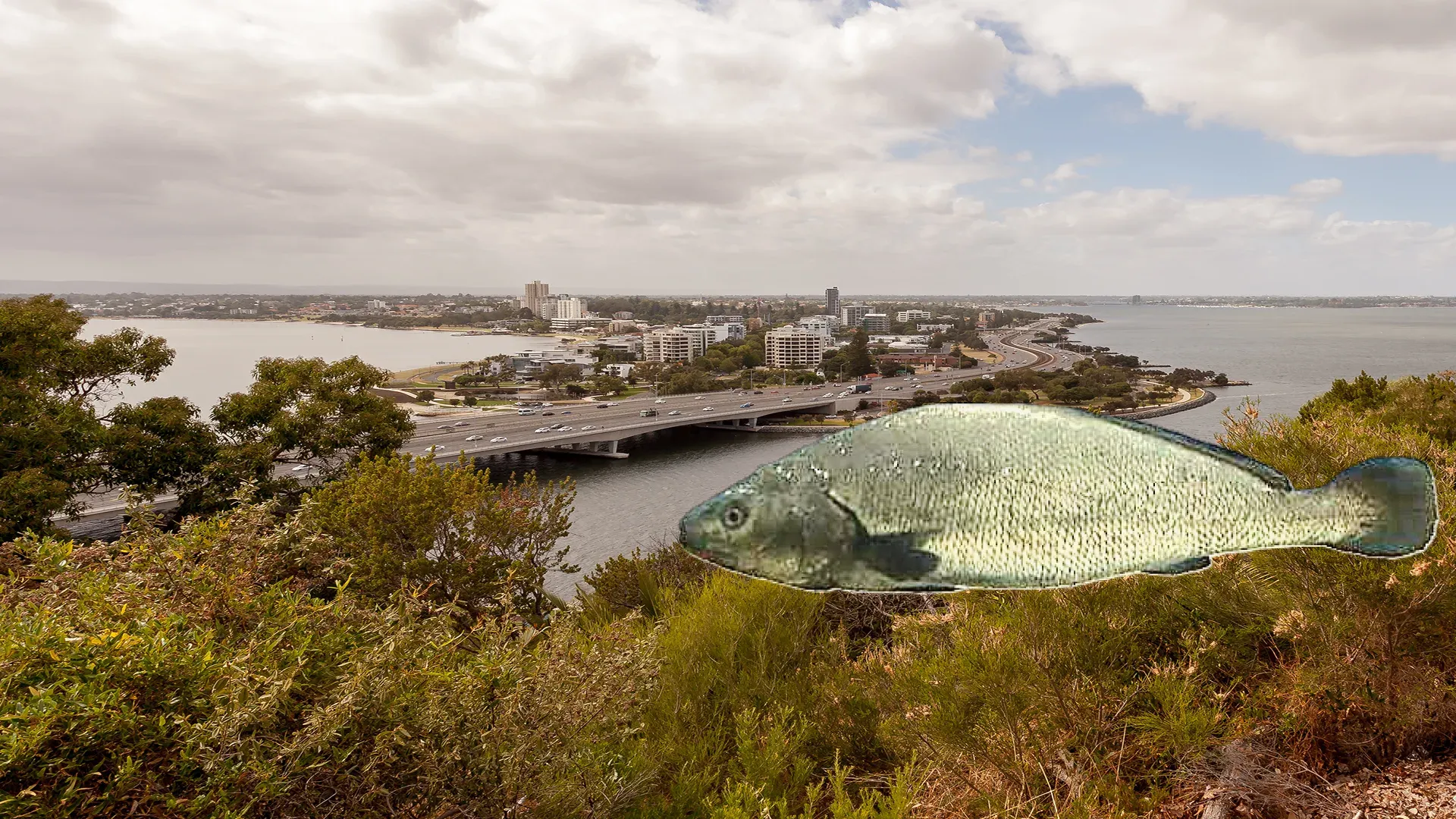
Target Species
Mulloway
Swan River is one of the premier waterways for mulloway fishing in WA, with deep holes and bridge structure right in the middle of Perth and genuine metre-plus fish every season. Fish live or fresh bait on the bottom at night around the Narrows, Blackwall Reach, Mosman Bay and Point Walter, timed to the change of the tide.
Few angling pursuits in Western Australia match the raw drama of targeting river jewfish beneath the glowing city skyline of Perth. The Swan River cuts through limestone ridges and broad suburban flats before draining into the Indian Ocean at Fremantle, creating an estuary ecosystem packed with forage fish, deep current scour holes, and sprawling shadow lines. For generations of local anglers, the call of the river Mulloway (Argyrosomus japonicus) has meant bitter winter nights, quiet vigils on wooden jetties, and hours spent jigging up live mullet and scooping prawns in the shallows.
What separates the Swan River from other Australian estuaries is its unique combination of extreme urban accessibility and genuine trophy potential. Big fish cruise mere metres from roaring freeway traffic at the Narrows Bridge, hold deep against the sheer underwater cliffs of Blackwall Reach, and hunt bait along the sandy shelf at Point Walter. Whether you are stepping down from the limestone revetment walls with a long cast outfit or sounding deep holes from a trailer boat, the river rewards methodical preparation, precise tidal timing, and absolute noise discipline.
Cracking the code on Swan River Mulloway demands an understanding of seasonal salinity wedges, bridge pylon back-eddies, and bait migrations. Anglers who rush down with standard estuary gear usually end up with broken lines or long nights staring at untouched baits. This guide covers the precise underwater geography, seasonal movements, live-bait choices, and specialized presentations required to consistently cross paths with Western Australia’s most revered inshore predator. If you are just starting out with estuary sportfishing, read through our fishing basics guide to dial in foundational principles before tackling this challenging quarry.
Getting There
Mulloway
Argyrosomus japonicus
Always check current NSW DPI regulations before fishing. Bag and size limits may change.
Understanding Swan River: Location Intelligence
To catch Mulloway consistently in the Swan River, you must look beneath the mirror-smooth surface of the estuary and interpret its hidden hydrographic architecture. The Swan is a micro-tidal estuary, meaning daily water fluctuations rarely exceed one metre, yet small changes in tidal amplitude trigger massive water exchanges through the narrow Fremantle harbour entrance. Saltwater pushes up the basin beneath lighter fresh river water, establishing a stratified salt wedge that drives where baitfish school and where Mulloway stage to hunt.
The river’s deepest structural contours dictate the movements of mature fish. Between Bicton and Mosman Bay lies Blackwall Reach, where vertical limestone cliffs plunge straight down to depths between 12 and 21 metres. This cavernous canyon acts as a refuge, holding schools of large fish through bright daylight hours and periods of heavy winter run-off. Acoustic research in the lower Swan has recorded mulloway calling in spawning aggregations around Mosman Bay from late spring through summer, and the fish use these quiet, dark depths to rest before moving into the shallows under the cover of night.
Further upriver, the basin opens into Melville Water before constricting tightly between Mill Point and Mount Eliza at the Narrows Bridge. The Narrows is arguably the most famous Mulloway location in metropolitan Western Australia. Concrete bridge pylons interrupt the surging tidal flow, gouging out deep holes in the sandy riverbed and forming distinct upstream pressure cushions and downstream eddies. Mulloway hold behind these pylons, conserving energy while watching the overhead light-to-shadow line created by vehicular traffic. As schooling mullet, tailor, and yellowtail grunter sweep through the bridge arches, Mulloway rush upward from the deeper pockets to intercept them on the edge of the dark current seam.
Upstream of the city, the river bends past the Causeway bridges towards Burswood and Maylands, transitioning into mudflats and deep clay holes around Ashfield Flats and Ron Courtney Island. While these upper reaches feature lower overall salinity during wet winters, warm summer evenings draw massive schools of river prawns and juvenile baitfish. Big breeding Mulloway willingly push past the brackish boundary lines to gorge themselves in water barely three metres deep. Exploring deep holes at Ashfield Flats can yield exceptional sport with much lower angler pressure than the bustling bridges downriver.
Another critical underwater landmark is the sand spit at Point Walter. Here, an extended shallow sandbar thrusts outward into deep channel currents. On a dropping tide, schools of forage fish that fed over the shallow sand bank are forced into deep water along the drop-off, creating an ambush point that Mulloway patrol with ruthless efficiency. Down towards Bicton Baths and the surrounding stone groynes, higher salinity water straight from the ocean keeps Mulloway active even during early winter downpours, offering shore anglers clean water when the upper river turns tea-coloured from storm run-off. The same sandbar is one of the best tailor marks in Perth, covered in our Swan River chopper tailor guide, and the surrounding flats are prime ground for our Swan River topwater whiting guide.
Location Essentials
Swan River
-32.0220, 115.7800
When Is the Best Time to Fish for Mulloway at Swan River?
The best time to fish for mulloway in the Swan River is during the change of tide at night, especially between dusk and midnight or during the pre-dawn window when feeding predators cruise the drop-offs and bridge shadow lines under low ambient light.
Mulloway are nocturnal apex hunters with acute lateral lines and specialized hearing designed to locate prey in zero visibility. While occasional fish are landed during bright daylight hours in deep holes, your catch rate multiplies once the sun dips below the horizon. The river transforms after dark. Fidgety shoals of sea mullet and river garfish push toward surface lights, and resident tailor patrol the edge of the wash, drawing the river jewfish out from deep structure to ambush prey along the drop-offs.
Tidal movement is the single most important environmental trigger in the Swan estuary. Because the river features micro-tides with an average rise and fall often under one metre, current flow is concentrated around specific choke points like the Narrows, Fremantle Harbour, and Canning Bridge. You want moving water, but not torrential velocity. The optimal bite window almost always opens forty-five minutes before the high tide slack water and persists until roughly an hour after the water starts running out. During this slack period, large mulloway expend minimal energy while patrolling the flats and channel edges.
A secondary feeding window routinely opens around two o’clock in the morning. When boat traffic ceases and human disturbance on the riverbanks drops to zero, big fish will move right up into two metres of water along sandbanks like Point Walter or the flats near Ashfield. The final productive window occurs during the false dawn, forty-five minutes before sunrise. At this time, predatory fish push bait against retaining walls and pylon clusters before retreating back to eight to twelve metres of water in Blackwall Reach or Mosman Bay.
Barometric pressure also dictates mulloway behaviour. A steady or slowly falling barometer associated with approaching frontal systems, often called mulloway weather by local fishos, triggers aggressive feeding runs. Conversely, a sharp post-frontal spike in pressure will often shut the bite down, forcing fish tight against the mud bottom where they refuse even the freshest live bait.
Tide Times
Optimal Tide
Night-time high tide change with moderate water movement
Tide movement is critical for fish activity. Most species feed actively during tide changes, especially the run-in (incoming) tide.
Detailed hourly tide charts
Official tide predictions
7-day tide calendar
Tide Guide
Best for most species. Fish move in to feed as water rises.
Good for ambush predators. Baitfish get swept out.
Slower bite. Fish less active during slack water.
New/full moon. Bigger tidal range, more fish movement.
Moon Phase & Solunar
Moon phases influence fish feeding behavior. New and full moons create spring tides with stronger currents and increased fish activity.
Best Phases
- New Moon: Peak feeding activity, spring tides, excellent fishing
- Full Moon: Strong tides, night feeding, great for nocturnal species
- 3 Days Either Side: Extended peak period for maximum results
Major/Minor Periods
- Major Periods: Moon overhead/underfoot (2-3 hours)
- Minor Periods: Moon rise/set (1-2 hours)
- Best Times: Major period + dawn/dusk = explosive action
Weather Conditions
Check current conditions before heading out. Wind, swell, and barometric pressure significantly affect fish behavior.
Official forecasts, warnings & radar
Hourly wind speed & direction
Swell height, period & direction
The Bridge Shadow Line Principle
Never cast your bait directly into brightly lit water under bridge fixtures. Mulloway hold on the bottom inside the pitch-black shadow line, looking upward into the light pool. Position your bait two to three metres inside the dark edge where passing mullet or tailor silhouette against the illumination above.
Mulloway Seasonal Calendar
What Tackle Do You Need for Mulloway at Swan River?
To catch mulloway in the Swan River, you need a 7 to 9 foot medium-heavy spinning rod rated for 6 to 12 kilograms, matched with a 4000 to 5000 size reel spooled with 20 to 30 pound braid and a durable 40 to 60 pound fluorocarbon leader to handle structure and abrasive river bottoms.
Selecting gear for Swan River jewfish requires balancing sensitivity with brute stopping power. Mulloway are notorious for soft, deliberate takes where they mouth a bait before turning to run. If your rod tip is as stiff as a broom handle, the fish will feel unusual resistance and drop the offering instantly. However, fishing around structure like the Narrows Bridge pylons, Fremantle rail bridge footings, or the jagged limestone ledges of Blackwall Reach means you cannot afford a soft underbelly once the hook finds home. For more gear guidance across different environments, explore our tackle basics guide.
For land-based anglers tossing live baits from shore platforms, a rod measuring between 8 foot 6 inches and 9 foot provides the clearance needed to cast heavy sinkers beyond shore ledges and lift line clear of riverside rocks. Boat anglers should opt for a shorter 7 foot to 7 foot 6 inch graphite blank that allows better use directly beneath the hull when lifting stubborn fish out of 10 metres of water. If you’ve fished for jewies in Victoria, the gear overlaps heavily with our Barwon River mulloway guide.
Your reel must feature a carbon drag system that yields line smoothly without the slightest hesitation. When a metre-plus mulloway makes its first uninterrupted 40-metre run into the tide, sticky drag washers will snap your leader or tear the hook out of the fish’s soft jaw. While mainline braid of 20 to 30-pound breaking strain offers the slim diameter required to cut through tidal currents without creating excessive bow in the line, your leader must step up. Use at least 40-pound, and preferably 50 to 60-pound, abrasion-resistant fluorocarbon. Large mulloway have rough pads of crushing teeth that abrade soft monofilament during extended battles, and Swan River structure is coated in razor-sharp barnacles and submerged timber.
Complete Tackle Specifications for Swan River Mulloway
| Component | Specification |
|---|---|
| Boat Rod | 7ft to 7ft 6in graphite spin, 6-10kg or 8-12kg rating with moderate-fast action |
| Shore Rod | 8ft 6in to 9ft medium-heavy spin blank, 8-15kg rating with sensitive tip |
| Spin Reel | 4000 to 5000 size with minimum 9kg sealed carbon drag system |
| Main Line | 20lb to 30lb high-grade 8-carrier PE braid for minimal water resistance |
| Shock Leader | 40lb to 60lb heavy-duty fluorocarbon, 1.2m to 1.8m in length |
| Terminal Hooks | Two 5/0 to 7/0 octopus circle hooks or suicide hooks snelled in tandem |
| Sinker Selection | Size 2 to 6 star or ball sinkers matched to water depth and current speed |
| Terminal Swivel | Size 4 to 6 heavy brass rolling or crane swivel, rated 80lb+ |
How Do You Rig for Mulloway?
The most reliable rig for mulloway in the Swan River is a running sinker rig featuring a free-sliding ball or star sinker running down to a quality swivel, followed by a 1.2 to 1.5 metre trace of 50-pound fluorocarbon tied to a tandem snell hook setup.
Presentation is paramount when pursuing river jewfish. Mulloway possess exceptional sensory abilities and will immediately eject an offering if they detect unusual weight or tension as they pick up a bait. The running sinker rig remains the undisputed king of bait fishing rigs in the Swan estuary because it allows line to peel through the sinker weight unhindered while the fish swallows the bait. To study alternative setups for open beaches and estuaries, take a look at our essential fishing rigs resource.
Setting your tandem hooks correctly makes all the difference when dealing with live bait or big fish fillets. Snelled twin hooks provide two firm contact points, which vastly improves hook-up rates compared to single-hook rigs. When a mulloway grabs a legal-sized live tailor or sea mullet, it almost always takes the prey head-first. Having the lead hook positioned near the head or nostrils and the trailing hook placed cleanly near the dorsal or anal fin guarantees solid hook penetration whether the fish strikes short or engulfs the whole offering. Tying your own leaders also ensures total knot integrity; inspect our guide on essential fishing knots to master snelling and loop construction.
Building the Swan River Running Snelled Rig
- 1
Thread the Sinker and Buffer Bead
Slide an appropriate ball or star sinker onto your braided mainline, followed by a 6mm rubber buffer bead to prevent the sinker from damaging your mainline knot against the terminal swivel.
- 2
Tie off Mainline to Heavy Swivel
Secure your mainline to one eye of a heavy-duty size 4 rolling swivel using a reinforced Palomar knot or Uni knot, trimming the tag end neat and flush.
- 3
Cut Leader to Length
Measure out approximately 1.5 metres of 50-pound to 60-pound fluorocarbon leader material. Length is essential to give the bait freedom of natural movement away from the sinker on the river bed.
- 4
Snell the Trailing Hook
Take a 5/0 or 6/0 suicide or octopus hook and snell it onto the bottom end of the fluorocarbon trace, using at least seven snug wraps around the shank to lock it firmly in place.
- 5
Snell the Sliding Top Hook
Thread the top hook onto the leader line, sliding it down until it sits roughly 8 to 12 centimetres above the trailing hook. Wrap the snell knot down the shank so the hook remains firmly in place under line tension.
- 6
Join Trace to Swivel
Tie the open end of your fluorocarbon leader to the bottom eye of your mainline swivel using a five-turn Uni knot or improved Clinch knot, pulling the wraps down tight with pliers.
- 7
Test and Inspect Under Load
Grip both hooks safely with pliers while securing the swivel to test the snell knots under heavy hand tension, inspecting the entire leader for micro-abrasions before baiting up.
What Bait Works Best for Mulloway?
The most effective bait for mulloway in the Swan River is a fresh live sea mullet or live tailor between 18 and 30 centimetres, while fresh local river prawns and fresh-cut slabs of tailor or mullet rank as dependable secondary options.
Mulloway are predatory opportunists with a discerning palate. If your bait has spent weeks in a freezer, desiccated by freezer burn and devoid of scent oils, leave it at home. In an estuary packed with healthy juvenile fish and seasonal crustacean hatches, jewfish turn their noses up at dead, washed-out offerings. Sourcing live, locally caught bait right out of the Swan is the single most effective way to turn hours of waiting into reel-screaming runs. You can compare seasonal baits across our fishing bait guide to see how different species behave in varied salinities.
Live sea mullet are the premier choice throughout the Swan system. They are tough, survive for hours in a livewell or bait bucket with a battery aerator, and emit frantic low-frequency vibrations when tethered to a running sinker on the bottom. Yellow-eye mullet and river garfish are equally effective when fished over sandbars like Point Walter or along the drop-offs at Mosman Bay.
Live tailor are another lethal weapon, particularly near the Narrows Bridge and Fremantle Harbour where tailor schools gather beneath streetlights. Remember that Western Australian regulations mandate a minimum legal size limit of 30 centimetres for tailor; using undersized tailor as live bait is illegal, regardless of how attractive they look to an angler. Hooking a legal 30-centimetre tailor through the bridle or back muscle below the dorsal fin presents a substantial, splashing target that large trophy mulloway cannot ignore.
During the balmy mid-summer months, schooling king prawns migrate down the river channel. Large mulloway will position themselves under the Canning Bridge pylons and along the Bicton Baths wall to hoover up these crustaceans in the upper water column. Threading two or three live prawns onto a lighter gauge hook and drifting them unweighted down the tide line can produce stunning results when the fish are dialed in on surface feeds.
Swan River Mulloway Bait Performance Analysis
| Live Sea Mullet | Live Tailor (Legal) | Fresh Slab / Fillet | Live River Prawns | |
|---|---|---|---|---|
| Effectiveness Rating | Outstanding (5/5) | Outstanding (5/5) | Very Good (4/5) | Exceptional in Summer (5/5) |
| Durability on Hook | High (stays lively 1-2 hrs) | Moderate (delicate jaws) | Moderate (pickers pick away) | Low (easily stripped) |
| Scent Dispersion | Moderate (vibration focused) | High (bloody, thrashing) | Very High (natural oils and blood) | High (natural river scent) |
| Availability | High (bait jigs or light line) | Moderate (catch on lures first) | High (from fresh catch or shop) | Seasonal (summer prawn run) |
| Best Use Conditions | Deep holes, bridge pylons, fast runs | Open channels, river mouth, night tides | Dirty water after rain, slack tides | Light tackle near bridge pylons, top water |
The Tailor Butterfly Technique
When live bait is unavailable, take a freshly caught legal tailor and butterfly it. Scale the flank, remove the central backbone from behind the gill plate to the tail wrist, but leave the head intact with the twin side fillets fluttering freely in the current. The scent trail of fresh fish oil washed down the current is irresistible to passing mulloway.
How Do You Catch Mulloway at Swan River?
To catch Mulloway in the Swan River, present fresh or live bait right on the bottom along deep channel edges, bridge pylon shadow lines, and drop-offs during tide changes. Mulloway hunt upstream into the tidal current under cover of darkness, requiring patient bait placement and minimal terminal resistance so the fish can take line freely.
Cracking the river jewfish code comes down to three operational phases: placement, strike detection, and extracting fish from gnarly urban structure. Learning how to blend these phases into your session will fast-track your progression from sitting on empty rods to holding silver bars on the bank. If you want a wider rundown on reading structure and currents across other estuaries, our detailed guide on fishing techniques breaks down the core fundamentals.
Casting Strategy and Bait Placement
Accuracy counts for far more than casting distance when hunting river Mulloway. Schooling mulloway do not graze randomly across mud flats. They patrol well-defined travel lanes dictated by bottom topography and current speed. When fishing around bridges like the Narrows or the Causeway, aim to land your bait five to ten metres upstream of the shadow line where the bridge floodlights cast hard darkness across the river surface. Your sinker must settle securely so your live bait swims in that dark margin, where predatory jewfish sit in ambush watching for disoriented baitfish drifting downstream in the light.
When targeting natural ledges like Blackwall Reach or Mosman Bay, cast at a 45-degree angle up-current. Allow your rig to sink freely on a semi-slack line until you feel the sinker anchor into the bottom. Feeding out three or four metres of slack line after touchdown creates a subtle belly in the water, stopping the river current from dragging your sinker across the bottom and rolling your bait under snags. For deep-water lure work, position your boat or kayak upstream of a drop-off, cast your paddle-tail or soft vibe down into the deep hole, and work the lure back up the slope with gentle hops, keeping contact with the bottom substrate at all times.
Bite Detection and Hookset
Mulloway bites rarely match the aggressive tearing runs of a tailor or pelagic fish. The typical take begins as a series of deliberate, rhythmic taps, known by river regulars as the “mulloway knock”. This tap-tap sensation is the fish crushing the baitfish with its pharyngeal plates before turning it around head-first to swallow.
The usual sequence is the tap-tap of the fish crushing the bait (baitrunner open), then a slow, peeling run (count three to five seconds), then a firm strike as you lock up the drag.
How you react depends entirely on your terminal hook configuration:
- When using snelled suicide hooks: Fish with a loose baitrunner drag or an open bail arm held lightly under an elastic band on the rod grip. Let the fish peel line smoothly for three to five seconds without feeling stiff resistance. Once the run speeds up into a deliberate, steady draw, point the rod tip down along the line angle, close the bail or engage the drag, wind down firmly until you feel heavy weight, and sweep the rod back in a long, powerful strike to punch the heavy gauge hook through the jaw cartilage.
- When using circle hooks: Never strike. Keep your rod seated in a solid bank holder with the reel set to your fighting drag. As the mulloway runs, the line tightens naturally across the jaw corner, rolling the circle hook into the hinge of the mouth. Simply pick up the rod, lift the tip, and begin winding steadily. Striking with a circle hook pulls the point straight out of the fish’s throat before it has a chance to turn.
Fighting and Landing Strategies
The opening thirty seconds of a Swan River mulloway battle decide the outcome. Big river jewies make powerful, sustained bursts toward bridge pylons, sunken moorings, and sharp limestone shelves. Keep your rod tip elevated at a 45-degree angle and maintain constant, smooth pressure. Dropping rod angle or introducing slack line gives the fish an opportunity to rub your leader across barnacle-encrusted concrete or limestone ledges.
If the fish heads toward a bridge pylon, drop your rod tip laterally toward the opposite bank to apply side-strain and turn its head away from the hazard. Avoid frantic pumping of the rod. Lift slowly and wind line onto the spool on the downward stroke, using your reel drag to tire the fish out smoothly.
Landing your mulloway requires cool nerves at the water’s edge. Never attempt to lift a jewfish from the water by the leader, as the sudden surge of a thrashing fish will shear twenty-pound or thirty-pound fluorocarbon instantly. Guide the beaten fish head-first into a large knotless landing net submerged beneath the surface. If fishing from a high jetty or steep rock wall where a net cannot reach, use a designated drop-net or lead the fish into a shallow beach access point. Land-based anglers must always carry a long-handled net or arrange a secondary landing spot before their first cast of the night.
Can You Hear Mulloway Croaking in Mosman Bay?
Yes. Mulloway make a deep grunting or croaking call with their swim bladder, and on a calm, quiet evening in Mosman Bay you can sometimes hear them from a boat or the bank. The calling is strongest from late spring through summer, once the river warms past about 18.5°C, and it is a good sign that fish are gathered nearby.
Mulloway belong to the croaker and drum family, and the name fits. They drum their swim bladder with specialised muscles to produce a low, repetitive grunt, and in the lower Swan they do it in numbers. Curtin University researchers spent several seasons recording a calling aggregation in Mosman Bay with underwater hydrophones. They found the chorus builds in the evening, switches on and off with water temperature at around 18.5°C, and shifts position around the bay from night to night.
On still nights, local anglers sitting quietly in the bay among the boat moorings off Mosman Park sometimes hear the fish across the water: a deep, knocking croak that sounds nothing like the slap of baitfish. Treat it as a clue, not a guarantee. Calling fish are often preoccupied with spawning and can be fussy, but the sound tells you the school is close. Hearing it is the cue to put a fresh live mullet or tailor on the bottom along the nearest drop-off, kill your torch and engine noise, and stay patient through the change of tide.
A few rules of thumb for fishing around the moorings:
- Pick your night: Late October to February, on a calm evening with little wind or boat traffic, gives you the best chance of hearing them. Turn off music and sounders and listen for a few minutes before you start fishing.
- Fish the edges, not the hulls: Anchor clear of the moored boats and set baits along the drop-offs and in the shadows between them. Never tie up to a private mooring, and keep your anchor and lines well away from mooring chains.
- Expect to be cut off: Mooring chains and blocks are abrasive, so run the heavier 50 to 60-pound leader and turn the fish’s head early when it runs for them.
- Go easy on the breeders: The calling fish are adults gathered to spawn. Recfishwest notes that mulloway don’t start reproducing until 80 to 90cm, so photograph and release the big fish if you can.
What Are the Rules for Fishing at Swan River?
Mulloway in the Swan River have a 50 cm minimum legal length and a daily bag limit of 2 per person, which counts toward WA’s mixed nearshore/estuarine finfish limit of 16, under Department of Primary Industries and Regional Development (DPIRD) rules.
Staying on top of regional rules ensures our river stock stays healthy for future generations of anglers. The legal minimum is 50 cm, but West Australian mulloway don’t reach maturity until they’re roughly 80 to 90 cm long, so many local anglers release fish under 80 cm to give them at least one spawning season. No licence is needed to fish from the shore, but you need a Recreational Fishing from Boat Licence (RFBL) to fish from a powered boat, and recreational netting is closed in most WA estuaries, so catch your live bait on bait jigs or light line.
These limits were verified on 17 November 2026 against the official DPIRD mulloway rules. Confirm them on the DPIRD Recreational Fishing Rules page before each trip, and see our guide to fishing regulations in Australia for how mixed bag limits work.
Swan River Hazards and Safety Protocols
Fishing the Swan River at night or around fast-flowing bridges brings real hazards that require preparation:
- Bull Shark Presence: Bull sharks move into the Swan River through the warmer months and use deep holes like Blackwall Reach and Mosman Bay. Check SharkSmart for recent sightings. Never wade out past your knees to land a fish in murky water, and never tether caught fish to your waist or kayak.
- Slippery Limestone and Rock Walls: Wet limestone rocks at Bicton, Point Walter, and under bridge footings become slick as ice when spray or dew settles. Wear grippy footwear on stone surfaces.
- Swirling Currents: Bridge channels produce powerful undertows on running tides. If your gear snags, do not step into deep current channels to free it.
- Vessel Traffic: River ferries and private cruisers produce heavy wakes without warning along main river stretches. Ensure your tackle box and rod stands are anchored well above the high splash zone.
- Emergency Contact: In an emergency, call 000, or raise Fremantle Volunteer Sea Rescue on VHF Channel 16.
Best Practice Conservation Habits
Mulloway fight with immense heart and expend tremendous energy during a capture. If you intend to release your fish, apply these fish-handling steps to ensure it swims away healthy:
- Minimise Air Exposure: Keep the fish in the water inside the landing net while you prepare your camera and measuring mat. Limit out-of-water handling time to under sixty seconds.
- Support the Fish Horizontally: Never suspend a large mulloway vertically by the jaw or gills with lip-grippers. Lifting a heavy fish without belly support causes internal organ damage and separates spinal vertebrae. Support the weight beneath the belly and behind the pectoral fins with two wet hands.
- Use Barbless or Crushed-Barb Hooks: Squeezing down the barbs on large circle hooks speeds up hook removal and reduces mouth trauma, getting the fish back into the water without delay.
- Deep Water Barotrauma: When landing mulloway from holes deeper than ten metres, such as Blackwall Reach, fish may suffer expanded swim bladders. Keep a release weight or venting tool handy to help bloated fish descend back down to the river floor.
- Revive Thoroughly Before Release: Hold the fish facing into the gentle current in the water, supporting its underside until it regains tail rhythm and kicks strongly out of your grasp.
For a broader look at personal preparation and gear care on coastal waters, consult our overview on fishing safety in Australia.
Your Questions About Mulloway Fishing at Swan River
What is the best time to fish at Swan River?
The best time to fish for Mulloway at Swan River is during the change of tide between dusk and midnight, with the hour either side of the high tide slack water producing the most consistent bite window.
Focusing your efforts on peak fishing hours means pairing tidal slacks with dark conditions. Mulloway dislike strong daylight and raging currents in the river channels, so planning your arrivals around sunset during a slowing run-in tide gives you the highest chance of encountering active, feeding schools before the water turns still.
Is Swan River suitable for beginners?
Swan River offers good accessibility for beginners, though targeting Mulloway requires dedicated patience and intermediate tackle handling compared to general bread-and-butter river species.
If you are looking for beginner friendly fishing, starting out targeting smaller species like black bream or flathead from river jetties is a great stepping stone before putting in long, nocturnal vigils for mulloway. Our fishing basics guide covers the foundational skills you need before tackling large estuary predators.
Do I need a boat to fish at Swan River?
No, you do not need a boat to catch Mulloway at Swan River, as many of the most famous and productive fishing marks are entirely land-based structures like bridges, rock groynes, and foreshore reserves.
Land-based fishing for mulloway in the Swan is an established tradition with dozens of proven platforms. Spots like the Narrows Bridge walkway, the Causeway, Point Walter sandbar, and the Bicton Baths groyne give shore anglers direct casting access into deep drop-offs and current channels without owning a watercraft.
Where are the best specific spots at Swan River?
The most productive spots for Mulloway in the Swan River are the Narrows Bridge pylons, the deep limestone channel at Blackwall Reach, Mosman Bay, and the sandbar drop-off at Point Walter.
These river hot spots share specific attributes: access to water deeper than six metres, reliable bait schools like mullet and herring, and current breaks where predators can rest out of the main flow. If you enjoy exploring other southern estuaries with similar features, take a look at our guide to Mulloway at Glenelg River.
What size Mulloway can I expect?
Most Swan River mulloway are school fish of 50 to 75cm, while mature fish over 100cm are caught every season.
The average catch size runs around the 65cm to 75cm mark, offering sport on lighter estuary outfits. But because big breeding fish gather in the lower Swan each summer to spawn, every tap on your line could be a genuine river trophy.
Is there parking available at Swan River?
Yes, excellent public parking is located alongside major fishing locations including the South Perth foreshore, Point Walter reserve, Bicton Baths, and Point Resolution.
Foreshore access at the Narrows on the South Perth side has ticketed and free evening parking bays within an easy two-minute walk of the fishing platforms. Always check street signage for local council time limits, as daytime parking restrictions often ease after 6:00 pm, perfect for overnight sessions.
Can I fish at night at Swan River?
Yes, night fishing is permitted across most public foreshores along the Swan River and is the most effective time to catch Mulloway.
Top night fishing tips include packing a dependable red-beam headlamp to preserve your night vision and prevent spooking fish cruising the shallows. Keep noise to a minimum by avoiding heavy footsteps on wooden jetties or dropping sinkers against boat hulls, as mulloway possess sensitive lateral lines that detect vibrations from long distances.
Where can I buy bait near Swan River?
You can buy bait and tackle from the tackle shops along Stirling Highway and Canning Highway, close to the lower river.
Local shops stock frozen prawns and mullet and can tell you where the fish have been holding. Many service stations along Canning Highway and Stirling Highway also stock emergency frozen squid and pilchards for late-night trips.
What are the current bag and size limits?
In Western Australia’s West Coast Bioregion, Mulloway carry a minimum legal length of 50cm and a daily recreational bag limit of 2 fish per person.
These limits apply throughout the Swan and Canning estuary. Be sure to carry a rigid brag mat to measure fish accurately from the snout tip to the end of the tail fin before keeping any catch.
Is Swan River family-friendly for fishing?
Yes, Swan River has numerous family-friendly parks with grassy banks, barbecues, playgrounds, and paved paths suitable for fishing with young children.
Safe fishing spots like Point Walter, Matilda Bay, and Deep Water Point offer sandy shorelines, railings, and zero ocean swell, making them pleasant locations to introduce kids to the water. While young children might struggle with the late-night hours needed for mulloway, these spots offer daytime chances at herring, whiting, and flathead.
What should I bring for a fishing session?
Your Swan River session requires a sturdy rod and reel setup, fresh bait or lures, a tackle kit, a headlamp, a large knotless landing net, and a warm windproof jacket.
Packing an organised fishing checklist ensures you do not get stranded at 1:00 am without essential tools. Include long-nose pliers for unhooking, a sharp bait knife, spare fluorocarbon leader spools, hook varieties, a measuring mat, and plenty of fresh drinking water to stay hydrated through long night shifts on the bank.
How crowded does Swan River get?
The Swan River can get quite busy during warm summer weekends, particularly around lighted bridges and popular jetties, but you can easily find peaceful water by moving away from primary parking areas.
For quieter sessions, target mid-week evenings, cooler winter nights, or rainy low-pressure weather windows when casual recreational crowds stay home. You can also compare this urban river experience with eastern hotspots like Mulloway at Queens Wharf or the well-known industrial waters of Mulloway at Yarra River. Every guide is collected on our mulloway species hub.
Stay Updated with Fishing Reports
Catching mulloway consistently relies on matching your plans to real-time bait movements and river conditions. Stay in touch with current river patterns, water clarity reports, and recent captures by checking our community updates:
Latest Fishing Reports
Stay updated with the latest catches, conditions, and hot tips from Swan River. Check these sources for recent reports filtered by location and species.
Fishraider
Community fishing reports and catch logs
Fishing World
Professional fishing reports and news
Tackle World
Local tackle shop reports and tips
NSW DPI
Official recreational fishing reports
Fishingmonthly
Monthly fishing magazine and reports
Hooked Up
Video fishing reports and tips
Pro Tip: Filter Reports
When browsing reports, search for "Swan River" or nearby landmarks. Look for reports from the last 7-14 days for the most relevant information. Pay attention to tide times, weather conditions, and successful techniques mentioned.
Share Your Catch
Caught something at Swan River? Share your success with the community! Upload your catch photos and reports to help other anglers.
Regulations, bag limits, and marine park zones are subject to change by state authorities. Always check current rules directly with the Department of Primary Industries and Regional Development (DPIRD) before heading out on the water. Heading south? Our Blackwood River black bream guide covers the best bream river in the South West. For more destinations, explore our fishing spots across Australia, learn more about different targets in our species guides, or pick up essential foundational knowledge in our fishing basics guide.
Quick Info
- Location
- Swan River
- Region
- Perth, WA
- Coordinates
- -32.0220, 115.7800
- Difficulty
- advanced
- Target Species
- Mulloway
Conditions
Check local weather and tide conditions before heading out.