Target Species
Samsonfish
Two Rocks Marina is one of the best land-based spots for samsonfish fishing in WA. Fish a live herring or yellowtail scad off the outer breakwall tips at dawn or dusk on a moving tide, on heavy spin gear with 80 to 100-pound leader. You get deep water close to the rocks, plenty of bait, and far less pressure than the metro rock walls further south.
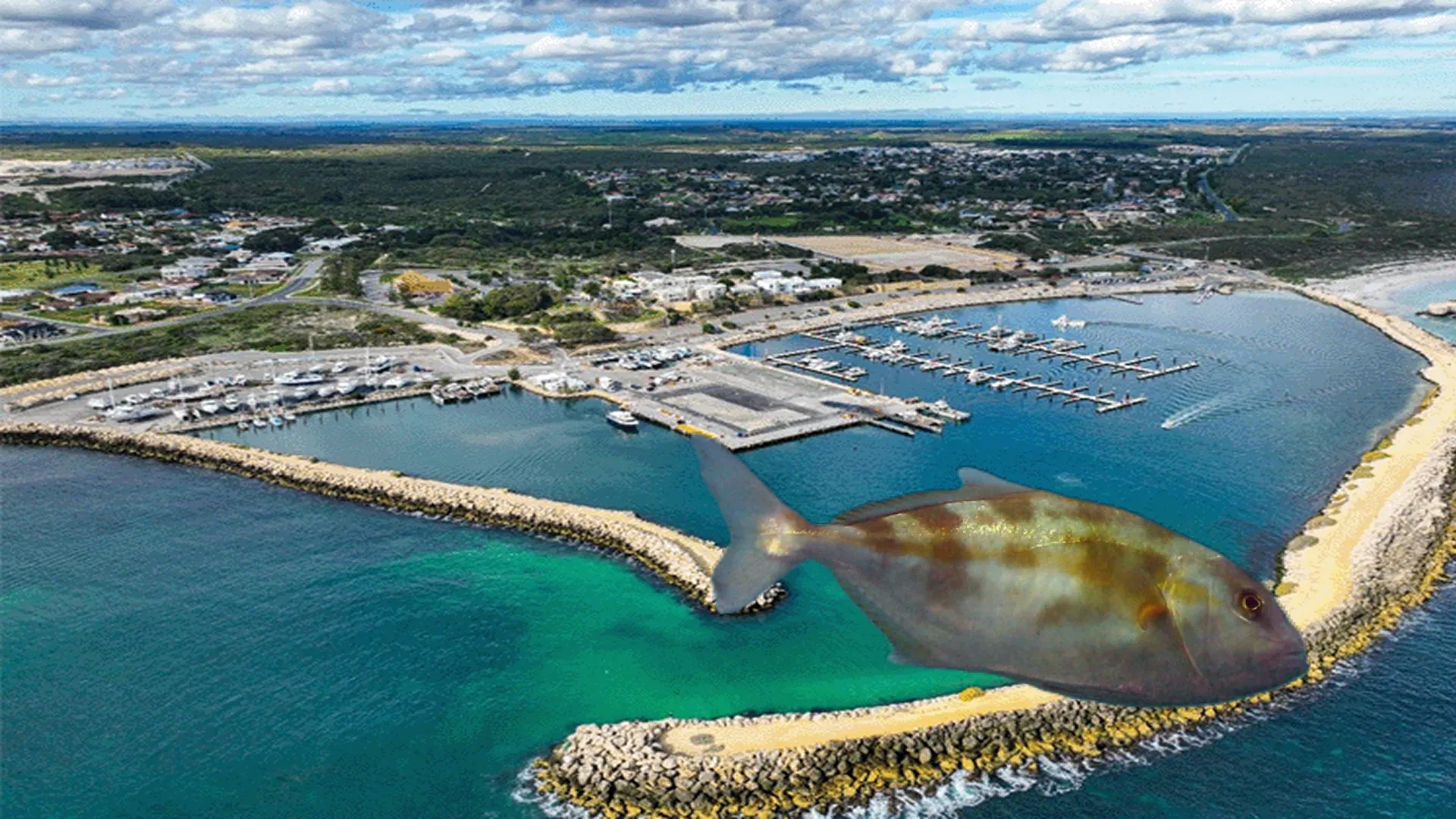
Perched on the northern fringe of the Perth metropolitan coastline, Two Rocks Marina marks the transition where urban sprawl gives way to the wild, reef-strewn expanses of the Turquoise Coast. Built in the 1970s as part of the Yanchep Sun City development and home to a working rock lobster fleet, the marina is enclosed by massive limestone breakwaters that the Department of Transport reinforced in a 2022 upgrade. For shore-based sport fishers, this venue presents a rare opportunity: the chance to hook a bona fide oceanic powerhouse, the Samsonfish (Seriola hippos), without stepping foot on a boat.
Known colloquially across Western Australia as “sambos”, these brutes are legendary for their unforgiving, vertical power dives, brutal head shakes, and uncanny ability to sever heavy monofilament across submerged limestone ledges within seconds of feeling steel. While boaters frequently target spawning aggregations in deep waters out past Rottnest Island, land-based anglers at Two Rocks intercept roving packs of juveniles and resident bruisers hunting baitfish pushed along the rocky perimeter.
This guide covers the structure, tides, seasons, and heavy tackle you need to land a shore-based sambo. If you fish the Perth metro walls too, our North Mole pink snapper guide covers Fremantle’s big breakwall, where samsonfish also turn up.
Getting There
Samsonfish
Seriola hippos
Always check current NSW DPI regulations before fishing. Bag and size limits may change.
Understanding Two Rocks Marina: Location Intelligence
Two Rocks Marina’s breakwaters act like an artificial reef, funnelling baitfish through a narrow entrance flanked by limestone reef. Samsonfish patrol the current lines and breakwall drop-offs, using the turbulence and the submerged rock armour to ambush prey.
To fish Two Rocks Marina effectively, you must understand the marine geography that shapes it. Unlike shallower, sand-dominated harbours situated along Perth’s inner metropolitan beaches, Two Rocks sits adjacent to an extensive offshore reef network. The two offshore limestone rocks that give the town its name sit just off the marina. These shallow outcrops break heavy ocean swells, split incoming swell energy, and create complex cross-currents that push schools of bait into the deeper entrance channel.
The marina breakwaters themselves are built from large quarried limestone blocks. Over decades, marine growth, kelp gardens, and encrusting shellfish have colonised the submerged footings, turning the structure into a thriving ecosystem. Depth outside the southern and western walls falls away quickly from 4 metres at the rock toe to 8 to 12 metres over broken limestone pavements and sand pockets. Within the shipping channel, continuous tidal displacement carves out a defined channel where Samsonfish patrol.
Samsonfish do not linger passively around structure. They are pelagic apex hunters that roam in small wolf packs, pushing schools of yellowtail scad (herring), sea mullet, blue sprat, and garfish against the rock wall. When the tide pushes hard, water rushes through the bottleneck between the northern and southern wall arms. This constriction creates an eddy line where baitfish struggle against the flow, giving larger predators an ambush station.
Anglers fishing from the breakwall must pay careful attention to the transition zones where the rock structure meets open water. The outer western elbow of the northern breakwater and the southern wall tip offer prime positioning to cast into deep water. Beneath the surface, the rocks slope out at an angle of roughly forty-five degrees, extending outward for five to eight metres before meeting the seabed. This submerged rock apron is where the majority of lost fish occur. A hooked sambo will immediately drop its head and power straight into these razor-sharp edges. Recognizing how the bottom drops away helps you determine your fighting angle, the required drag pressures, and where to position your landing net or gaff before you cast your bait.
Location Essentials
Two Rocks Marina
-31.4966, 115.5822
Seasonal shifts dramatically change the character of the marina entrance. During the calmer summer and early autumn mornings, light offshore easterly breezes groom the water flat, allowing high-clarity visibility into the deeper holes. In these conditions, Samsonfish can be seen cruising three to five metres down, their broad, bronze-olive flanks clearly identifiable. When the swell builds from the southwest, the two offshore limestone outcrops churn up white water. This surge sends turbulent plumes along the rock base, disorientating baitfish and sparking furious feeding bursts. Understanding how the interaction between swell, current, and structure dictates fish positioning is what separates regular blanks from consistent hook-ups on these heavy-hitting pelagics.
When Is the Best Time to Fish for Samsonfish at Two Rocks Marina?
The best time to target Samsonfish at Two Rocks Marina is during the low-light windows of dawn and dusk on a making tide. Peak feeding coincides with strong water movement through the entrance channel, particularly during the autumn months from March to May when baitfish schools mass along the limestone breakwalls.
Early morning sessions offer a distinct advantage along the outer walls. Before the sun breaks the horizon, the offshore easterly land breeze reliably flattens the coastal chop, creating flat water across the marina mouth. This calm surface allows Samsonfish to hunt aggressively in the upper water column. As first light illuminates the shallow reef edges, these predatory powerhouses pin schools of yellowtail scad and sea mullet hard against the rock armour. Anglers who position themselves at the seaward point thirty minutes before first light regularly encounter fish patrolling within ten metres of the rock face.
Dusk brings an equally intense feeding surge. As daylight fades between 5:30 pm and 7:30 pm, the sea breeze generally settles, and predatory pelagics push in from the deeper offshore reefs. The fish use the darkening water as cover to ambush herring and juvenile tailor that funnel out of the harbour basin. While Samsonfish are visual hunters that prefer daylight and twilight, night fishing during periods of bright moonlight can yield exceptional fish. Concentrated pools of light from the marina infrastructure illuminate the water, drawing thick schools of squid and baitfish. Samsonfish will cruise silently along the shadow line, darting into the lit zones to smash unsuspecting prey.
Tidal movement serves as the primary feeding trigger at Two Rocks. Because the astronomical tide range in south-west Western Australia is relatively small, rarely exceeding one metre, the speed of water exchange through the narrow marina mouth is critical. The optimal scenario occurs during a surging flood tide that pushes ocean water into the channel, forcing bait against the outer arm. Neap tides with little movement produce sluggish, indifferent fish that ignore baits. Conversely, spring tides around the new and full moon create rushing gutters through the entrance, forcing Samsonfish to hold station in the eddy lines where they readily take live baits and fast-retrieved metal slugs. Learn more about reading water movement in our guide on fishing techniques and tides.
Samsonfish Seasonal Calendar
Tide Times
Optimal Tide
Incoming flood tide during dawn or dusk, with strong water exchange through the channel mouth
Tide movement is critical for fish activity. Most species feed actively during tide changes, especially the run-in (incoming) tide.
Detailed hourly tide charts
Official tide predictions
7-day tide calendar
Tide Guide
Best for most species. Fish move in to feed as water rises.
Good for ambush predators. Baitfish get swept out.
Slower bite. Fish less active during slack water.
New/full moon. Bigger tidal range, more fish movement.
Moon Phase & Solunar
Moon phases influence fish feeding behavior. New and full moons create spring tides with stronger currents and increased fish activity.
Best Phases
- New Moon: Peak feeding activity, spring tides, excellent fishing
- Full Moon: Strong tides, night feeding, great for nocturnal species
- 3 Days Either Side: Extended peak period for maximum results
Major/Minor Periods
- Major Periods: Moon overhead/underfoot (2-3 hours)
- Minor Periods: Moon rise/set (1-2 hours)
- Best Times: Major period + dawn/dusk = explosive action
Weather Conditions
Check current conditions before heading out. Wind, swell, and barometric pressure significantly affect fish behavior.
Official forecasts, warnings & radar
Hourly wind speed & direction
Swell height, period & direction
Track the Easterly Wind Drop
Set your alarm for 4:30 am when the Bureau of Meteorology forecasts moderate offshore easterlies dropping out around 8:00 am. The easterly wind grooms the ocean surface flat against the western wall, allowing you to spot Samsonfish cruising the drop-off before the afternoon sea breeze arrives to churn up the channel.
What Tackle Do You Need for Samsonfish at Two Rocks Marina?
Targeting Samsonfish from the Two Rocks Marina breakwalls requires heavy tackle consisting of an 8 to 9 foot heavy spin rod rated PE 4 to 6 paired with a high-capacity 8000 to 10000 spin reel packing at least 12 kilograms of reliable drag. Heavy 50 to 65 pound braid joined to an 80 to 100 pound fluorocarbon leader is non-negotiable to survive the razor-sharp limestone ledges.
Land-based Samsonfish fishing is an unforgiving pursuit that will instantly expose any weakness in your gear. Unlike boat anglers who can position themselves directly over deep water and drive fish away from structure, rock anglers at Two Rocks must fight these brute pelagics on a horizontal plane across submerged limestone terraces. If you cast light gear here, you will be cut off within seconds of the hookup. For a foundational rundown of gear ratings, see our tackle essentials guide.
Your rod must possess two essential qualities: sufficient length to steer your line clear of nearshore boulders and a stiff lower third with massive lifting power. A rod measuring between 8 feet 6 inches and 9 feet 6 inches represents the sweet spot. It provides enough casting use to propel heavy baits and metal jigs into the outer channel while giving you the geometric clearance needed to pump a deep-diving fish away from the underwater wall footing. Fast-taper graphite composite rods deliver the necessary backbone without causing angler fatigue during prolonged, brutal battles.
Match this rod to an engineered saltwater spin reel built around a rigid aluminium body. Reel sizes in the 8000 to 10000 class from reputable makers are required, holding at least 300 metres of 50 to 65 pound multi-strand PE braid. The drag system must run smoothly under immense pressure without sticking or overheating. Samsonfish make blisteringly fast initial runs toward the seabed, and any hesitation in line release will shear your main line instantly.
Terminal tackle must be equally rugged. Standard monofilament leaders will fray and snap the moment they touch the abrasive calcified limestone. Run a minimum of two metres of 80 to 100 pound fluorocarbon leader connected via an FG knot or PR knot. Hooks must be forged, extra-heavy wire models; light gauge hooks will straighten under maximum drag before you turn the fish’s head.
Complete Tackle Specifications
| Component | Specification |
|---|---|
| Rod | 8ft 6in - 9ft 6in heavy spin, PE 4-6 rated, fast taper with heavy lifting backbone |
| Reel | 8000 - 10000 high-speed saltwater spin reel with minimum 12-15kg drag capacity |
| Main Line | 50 - 65lb 8-carrier PE braid, minimum 300m spool capacity |
| Leader | 80 - 100lb premium fluorocarbon leader, 2.0 - 2.5m connected with an FG knot |
| Hooks | 6/0 - 8/0 heavy gauge forged live bait hooks, or 7/0 inline singles for lures |
| Swivels | Size 1 - 1/0 heavy-duty ball bearing swivels rated to 100lb+ |
| Sinker | 3 - 6oz star or breakaway sinkers for bottom rigs; unweighted balloons for drifting |
| Rig Type | Suspended balloon drift rig, heavy single-dropper paternoster, or deep running sinker |
How Do You Rig for Samsonfish?
The most effective rig for Samsonfish at Two Rocks Marina is a heavy-duty live bait trace featuring an 80 to 100 pound fluorocarbon bite leader connected to a heavy ball-bearing swivel and a forged 7/0 live bait hook. This setup allows lively baitfish to swim freely near the surface or mid-water without becoming snagged on the bottom limestone.
Tying rigs for powerful coastal pelagics requires pristine knot work and zero tolerance for shortcuts. When a 15-kilogram Samsonfish turns its broad flank into the current, the structural pressure placed on every single junction is immense. Moisten monofilament and fluorocarbon before tightening a knot, because friction burn badly weakens the line. If you want to review core connections, check our detailed guide to essential fishing knots.
Two primary rigging styles dominate the marina walls: the suspended balloon rig and the heavy running sinker rig. The balloon rig is the undisputed champion when the easterly morning wind blows off the land. By tying an ordinary party balloon to your swivel with light monofilament, you can drift a struggling live herring or scad hundreds of metres out into the deep approach channel without requiring an enormous cast. The balloon keeps the bait elevated in the strike zone, well above the snag-infested reef, and signals strikes clearly when it disappears under the surface with a loud pop.
When the wind turns onshore or the fish are holding deep along the channel bottom, switch to a modified running sinker or heavy dropper rig. Keep leader lengths slightly shorter, around 1.5 metres, to retain crisp direct contact with the bait. This short connection prevents the baitfish from swimming behind limestone boulders and wrapping your rig around structure before a predator strikes. For more rigging diagrams, review our guide to essential Australian fishing rigs.
Building the Two Rocks Heavy Live-Bait Rig
- 1
Tie the Main Line Connection
Join your 50lb or 60lb braided main line to a 2.5 metre length of 80lb fluorocarbon leader using a slim, high-strength FG knot. Cinch the wraps down tightly until the braid darkens, then finish with alternating half hitches and an end knot.
- 2
Add Running Components
If fishing the bottom, slide a 4-ounce ball or torpedo sinker onto the leader, followed by a durable rubber buffer bead. If you plan to float baits out on the easterly breeze, skip the sinker and thread the line clean to the swivel.
- 3
Attach the Heavy Ball-Bearing Swivel
Secure the end of your leader to a genuine 100lb ball-bearing swivel using an improved clinch knot or a four-turn uni knot. Pull the knot firmly using pliers to ensure the heavy fluorocarbon seats cleanly against the swivel eye.
- 4
Construct the Bite Trace
Cut a 1.2 metre section of 100lb fluorocarbon for the terminal bite trace. Tie one end to the open ring of the ball-bearing swivel using a uni knot. This heavy trace provides crucial abrasion insurance when a fish rubs against the rock wall during the landing sequence.
- 5
Snell the Live Bait Hook
Snell a forged 7/0 or 8/0 heavy-wire live bait hook to the end of the bite trace. Ensure the line exits through the front of the eyelet toward the hook point. Snelling keeps the hook point aligned straight with the line pull, ensuring reliable hook sets in the jaw hinge.
- 6
Rig the Flotation Device
For surface drifting, inflate an ordinary party balloon to the size of a grapefruit. Tie the neck off, then use a 15 centimetre strand of light 6-pound monofilament to hitch the balloon knot directly to the upper eye of your ball-bearing swivel. This weak link snaps cleanly during the strike.
- 7
Secure and Inspect the Live Bait
Pin your live herring, mullet, or yellowtail scad through the tough shoulder meat just behind the head, taking care not to pierce the lateral line or spine. Check the entire rig for knicks, test the knot strength under full body weight, and ease the bait gently into the water.
What Bait Works Best for Samsonfish?
The single most productive bait for Samsonfish at Two Rocks Marina is a fresh, lively sea mullet or yellowtail scad between 15 and 25 centimetres in length. Live baits create strong vibrations that trigger defensive feeding strikes from passing Samsonfish, outperforming dead baits and frozen alternatives by a wide margin.
Samsonfish are apex hunters tuned to identify the rhythmic, low-frequency vibrations generated by distressed prey. While dead baits will pick up scavengers like rays or small sharks, an active live bait swimming erratically through the marina entrance will reliably summon a roaming Samsonfish from deep water. Collecting your bait on-site before your main session gives you the freshest, most effective offering possible. For detailed tips on bait presentation, explore our Australian fishing bait guide.
Australian herring, locally called tommy rough, are readily caught around the sheltered inner wall of the harbour using a light rod, a small float, and dough or raw prawn pieces. Herring make exceptional baits because their silvery sides flash brightly in the water column, and they survive well under heavy hook loads. Yellowtail scad, commonly known as yakka, are equally lethal. Yakkas naturally swim down toward mid-water structure, dragging your trace straight into the ambush territory where Samsonfish patrol.
When live bait is unavailable, whole fresh ocean squid is the undisputed king of dead baits. Avoid buying chemically bleached imported squid from generic supermarket freezers. Instead, catch fresh calamari directly from the marina walls under the floodlights at night, or source fresh locally caught squid from metropolitan tackle stores. A whole, unwashed squid rigged on a two-hook snelled trace releases heavy clouds of natural scent and displays an iridescent glow in the water that Samsonfish find irresistible. Fresh oily baitfish like whole pilchards, garfish, and mullet fillets represent worthy backup options, particularly when rigged on gang hooks and fished alongside an ongoing berley trail of minced fish scraps.
Bait Performance Analysis
| Live Sea Mullet / Herring | Whole Fresh Squid | Whole WA Pilchards | |
|---|---|---|---|
| Effectiveness Rating | Exceptional (9.5/10) | Very High (9/10) | Good (7.5/10) |
| Durability on Hook | High: stays active on hook for over an hour | Exceptional: tough mantle withstands picking pickers | Low: soft flesh thaws quickly and breaks apart in current |
| Scent Dispersion | Moderate: triggers lateral-line vibrations rather than oily scent | High: releases thick natural amino scent and ink residue | Very High: releases broad oil slick that travels down-current |
| Availability | Abundant inside marina walls around dawn and dusk | Moderate: requires nighttime jigging or specialty tackle purchase | Readily available at local petrol stations and tackle shops |
| Best Use Conditions | Calm mornings with flood tides and clear water clarity | Overcast days, low-light sessions, and night fishing around lighted walls | Rough seas, chopped-up water, and when establishing a berley trail |
The Saltwater Livewell Trick
Never crowd live baits into a small static bucket without aeration, as oxygen levels deplete within ten minutes, leaving your baits lethargic or dead. Keep a collapsible mesh bait keeper tied to the rocks on the sheltered marina side. Drop your hooked herring straight into the ocean bag as you catch them to guarantee every bait remains hyperactive when you pin it to your heavy game rig.
What Lures Work Best for Samsonfish at Two Rocks Marina?
The best lures for samsonfish off the Two Rocks breakwalls are 60 to 100 gram metal slugs cast wide and worked fast through the channel mouth, 120 to 160 mm floating stickbaits and poppers on calm summer and autumn mornings, and 5 to 7-inch soft plastics on heavy jigheads hopped along the drop-off. Swap all trebles for heavy inline singles.
Live bait catches the most samsonfish here, but lures let you cover the whole channel mouth and pick off the fish that are actively hunting. They also save you the hour it takes to catch and keep live bait, which matters on a short dawn window.
Metal Slugs and Casting Jigs
A 60 to 100 gram metal slug is the most reliable lure off the walls, because it casts into the wind and reaches the bottom of the channel quickly. Cast wide across the current, let it sink to the bottom on a tight line, then burn it back with a fast, erratic retrieve and short rod jerks. Samsonfish often hit as the lure lifts off the bottom or in the last ten metres before the rocks, so keep winding hard right to the wall. Lose the trebles: a single heavy inline hook hooks up just as well and snags the rocks far less.
Stickbaits and Poppers
From late spring to autumn, when bait is being smashed on the surface at first light, a 120 to 160 mm floating stickbait or cupped popper draws the most exciting strikes you will see from the rocks. Work stickbaits with long sweeps of the rod so they swim side to side under the surface, and poppers with sharp chugs and a pause. Surface lures need calm water to work properly, so save them for the easterly mornings and switch to metals once the sea breeze arrives.
Soft Plastics on Heavy Jigheads
When fish are holding deep and won’t chase a fast lure, a 5 to 7-inch paddletail or jerk shad on a 1 to 2-ounce jighead with a heavy hook gets down to them. Hop it along the edge of the channel drop-off with two sharp lifts and a pause, and expect strikes on the drop. You will lose some jigheads in the rocks, so fish the clean edge of the channel rather than straight into the rubble at the base of the wall.
Lure Selection for Two Rocks Samsonfish
| Metal Slugs | Stickbaits and Poppers | Soft Plastics | |
|---|---|---|---|
| Best Conditions | Any time, especially into the wind | Calm dawns with bait on the surface | Fish holding deep, slower tides |
| Size | 60 to 100g | 120 to 160mm | 5 to 7 inch on 1 to 2oz |
| Retrieve | Sink to bottom, burn back fast with jerks | Long sweeps or sharp chugs with pauses | Two lifts and a pause along the drop-off |
| Hook Setup | Single heavy inline hook | Heavy inline singles | Heavy-gauge jighead hook |
How Do You Catch Samsonfish at Two Rocks Marina?
Catching Samsonfish at Two Rocks Marina requires positioning your bait along the turbulent wash outside the entrance channel or near offshore limestone shelves, letting the current carry your scent trail into deep water, and reacting with a heavy strike before the fish charges back into the reef.
Landing a hard-fighting sambo from the Two Rocks rock walls demands sharp instincts, physical stamina, and methodical line management. These fish hit with sudden, ferocious energy and will instinctively turn downwards to shred your leader across sharp limestone bommies and shell-encrusted rock. Understanding how to present your bait, read the bite, and steer the fish into open water separates successful anglers from those left with snapped lines and empty spools. For a broader look at watercraft and reading currents, read through our guide on fishing techniques.
Casting Strategy and Bait Placement
Success at the marina wall comes down to putting your offering right into the active feeding lane without snagging the boulder foundation. Samsonfish cruise the deep drop-offs where the outgoing marina current collides with ocean swells. When casting from the southern groine or the north breakwater elbow, aim diagonally across the current rather than straight out. This angle allows your sinker to settle naturally along the edge of the channel drop-off instead of rolling directly into the rocks beneath your feet.
If you are deploying whole dead baits like mulies or fresh squid tubes on a running sinker rig, lob the bait out 30 to 50 metres, engage your reel spool, and gently take up slack until you feel bottom contact. If you are live-baiting with a slimy mackerel or sea mullet under a weighted float, cast up-current and let the tide push the bait past the outer points where big predatory fish hold. Keep your rod tip elevated at roughly 45 degrees to lift as much line off the water as possible, which prevents passing weed and surface chop from dragging your bait out of the strike zone. If you are casting heavy metal slugs or slow-pitch jigs, fan your casts across the channel mouth, allowing the metal to flutter all the way to the seafloor before beginning an erratic, high-speed vertical retrieve.
Bite Detection and Hookset
Samsonfish bites rarely resemble tentative pecks. On whole fish baits, a sambo often engulfs the bait while travelling at full pace, causing your rod tip to load instantly with terrifying speed. When using circle hooks, resist the urge to execute an aggressive, overhead strike. Striking hard with a circle hook pulls the point straight out of the fish’s mouth before it can find purchase. Instead, allow the rod to bend fully into the run, drop your rod tip slightly towards the water, and wind smoothly and rapidly into the fish until the heavy drag engages and rolls the hook into the corner of the jaw.
If you are running conventional J-hooks or a snelled suicide hook rig, you will feel a sharp double thud followed by an accelerating pull. Give the fish a second to turn with the bait, then drop your rod tip and set the hook with two firm upward sweeps of the rod. Waiting longer only gut-hooks fish you might want to release. If you detect a soft slack-line bite, reel like mad immediately, as a Samsonfish will frequently pick up a bait and swim straight up towards the surface or directly at the breakwater wall.
Fighting and Landing Strategies
The initial ten seconds of the fight will dictate whether you land the fish or lose your terminal tackle to the jagged reef. Once the hook is set, clamp down on your spool rim with your palm to apply extra stopping pressure during the first desperate run. You must turn the fish’s head away from the bottom structure immediately. Pump the rod with short, smooth, powerful strokes, gaining line on every downward motion. Never give a Samsonfish slack line, because any momentary release of tension allows the fish to dive headfirst into a limestone cavern or shake free.
As the fish tires and approaches the base of the breakwater, the fight enters its most dangerous stage. Samsonfish will circle stubbornly under your rod tip, trying to run your braid against the shallow armour rocks. Walk along the breakwater if necessary to keep your line clear of any protruding snags. Never attempt to lift a legal-sized Samsonfish onto the rocks using your rod, as the blank will likely snap. Guide the fish into a calm eddy between the rocks and use a long-handled landing net with a wide hoop, or carefully use a release lip gripper if you are standing on a secure, low ledge. If swell is surging up the rocks, time the landing with an incoming wave to gently slide the fish onto a flat platform, keeping your hands well clear of the gills and hooks.
What Are the Rules for Fishing at Two Rocks Marina?
Samsonfish at Two Rocks Marina have a 60 cm minimum legal length and fall under the mixed daily bag limit of three large pelagic finfish per person, set by the Department of Primary Industries and Regional Development (DPIRD).
Samsonfish belong to the large pelagic finfish group in Western Australia, so the three-fish limit is shared with species like yellowtail kingfish, amberjack, Spanish mackerel and tuna. Measure from the tip of the snout to the tip of the tail. No licence is needed to fish from the breakwalls, but you need a Recreational Fishing from Boat Licence (RFBL) to fish from a powered boat, and boaties targeting demersal species in the West Coast bioregion must carry a release weight.
These limits were verified on 17 November 2026 against the official DPIRD samsonfish rules. Confirm them on the DPIRD Recreational Fishing Rules page before each trip, and see our regulations guide for how WA’s mixed bag limits work.
Critical Safety Considerations
Two Rocks Marina breakwaters are steep, uneven rock that can be dangerously slippery when wet or covered in algae. Unpredictable ocean swells can break over the outer rocks without warning, particularly during high tide and heavy southwest swells. Always wear cleated rock-fishing footwear, wear a lifejacket on the outer walls, never turn your back on the ocean, and always fish with a mate. Check the Bureau of Meteorology swell forecast before you go, and in an emergency call 000.
Local Conservation Practices
Conserving the local fishery keeps Samsonfish populations healthy for future seasons. Adhere to these responsible angling habits whenever you target sambos off Two Rocks:
- Release the big breeders: Large samsonfish are important breeding stock, and big fish often carry a parasite that turns the flesh soft and mushy when cooked, so they’re poor eating anyway. Keep a legal school fish for the table and let the big ones go.
- Support fish during handling: Samsonfish have heavy internal organs that suffer severe damage if the fish is held vertically by the jaw. Always support the belly horizontally with a wet hand or a padded mat.
- Use barbless or single hooks: Swapping out treble hooks on lures for heavy-duty single inline hooks reduces tissue tearing and allows a clean, swift unhooking process on the rocks.
- Revive fish thoroughly before release: Long fights leave samsonfish exhausted. Hold the fish facing into the current or swish it gently forward in the water until it kicks away strongly under its own power.
- Dispose of waste properly: Never leave discarded monofilament, bait bags, or tangled braid on the rocks. Pack out all rubbish and use the marina bins to protect seabirds and marine life. Review our complete guide to fishing safety for more advice on safe rock platforms.
Your Questions About Samsonfish Fishing at Two Rocks Marina
What is the best time to fish at Two Rocks Marina?
The best time to target Samsonfish at Two Rocks Marina is during early morning dawn sessions and late afternoon dusk periods, especially when these coincide with the top of an incoming tide.
Peak fishing hours generally occur around first light because pelagic predators take advantage of low light conditions to hunt schools of herring, scad, and garfish close to the entrance rocks. Calm autumn mornings, when offshore easterly winds knock down the sea surface chop, give you optimal line control and bait visibility. Night sessions can produce fish, but dawn remains unmatched for explosive surface strikes.
Is Two Rocks Marina suitable for beginners?
Two Rocks Marina is beginner friendly inside the protected harbour basins, but the exposed outer breakwater walls require intermediate rock-scrambling and heavy-tackle handling skills.
Novice anglers can enjoy safe, easy fishing spots inside the marina along the internal boardwalks and sheltered rock walls, targeting herring, whiting, and squid on light spinning tackle. However, tackling Samsonfish along the ocean-facing rocks demands sure footing, heavy gear, and experience handling powerful fish around hazardous structure. Beginners hoping to catch a sambo should head out alongside an experienced rock angler.
Do I need a boat to fish at Two Rocks Marina?
No, you do not need a boat to catch Samsonfish at Two Rocks Marina because deep water runs directly past the outer breakwater tips, putting trophy pelagic fish within easy casting distance of shore anglers.
Land-based fishing from the southern breakwater and northern wall provides genuine access to ocean-going gamefish without launching a vessel. That said, boaties launching from the marina boat ramps can access shallow offshore limestone reefs and deep offshore pinnacles just a few nautical miles out, where massive schools of Samsonfish congregate in deeper water.
Where are the best specific spots at Two Rocks Marina?
The top fishing marks at Two Rocks Marina are the southern wall tip overlooking the main boating channel, the outer elbow of the northern breakwater, and the rocky wash facing the two offshore limestone outcrops.
These specific hot spots produce consistent action because tidal flow concentrates bait schools against the rocks. The entrance mouth is particularly effective during an outgoing tide, as baitfish exiting the protected harbour get swept straight past awaiting Samsonfish patrolling the drop-off. Always position yourself where you can safely land a fish without dropping down slick, sheer ledges.
What size Samsonfish can I expect?
Most samsonfish caught from the Two Rocks breakwaters are 65 to 95 centimetres, with the occasional fish over 110 centimetres.
The average catch size from the shore platform consists of juvenile to sub-adult sambos chasing bait schools along the coast. Bigger brute specimens cruise the channel mouth during seasonal migrations between late spring and early autumn. Boaties fishing the offshore summer aggregations catch much bigger fish, but any shore-caught sambo over 10 kilograms will push your tackle and stamina to the limit.
Is there parking available at Two Rocks Marina?
Yes, there is extensive free bitumen parking available directly adjacent to the Two Rocks boat ramps, marina boardwalk, and the southern breakwater access track.
Access is straightforward off Two Rocks Road via Enterprise Avenue or Sovereign Drive. The public car parks feature ample spaces, but parking spots can fill quickly on calm weekend mornings with trailer traffic. Anglers heading out to the outer rocks should park in designated vehicle bays near the marina entrance and walk along the public paths to reach the breakwaters.
Can I fish at night at Two Rocks Marina?
Yes, you can fish at night at Two Rocks Marina, and after-dark sessions are good for squid, tailor and mulloway, although samsonfish activity drops off once it’s fully dark.
Targeting sambos after dark is generally tough because they hunt primarily by sight, meaning dawn and dusk are far better options. However, night fishing tips for the marina include bringing a reliable headlamp, warm windproof clothing, and heavy lines if you are setting bottom baits for nocturnal predators like tailor, pink snapper, and sharks that patrol the rocky channel wash under cover of night.
Where can I buy bait near Two Rocks Marina?
You can buy frozen bait in Two Rocks and Yanchep, and the bigger tackle stores are further south around Clarkson and Joondalup.
Expect frozen mulies, squid, prawns and whitebait. If you prefer live bait, you can catch fresh herring, garfish, and yellowtail scad straight off the internal marina walls using light fluorocarbon line, small hooks, and bread berley before setting out for your main Samsonfish session.
What are the current bag and size limits?
In Western Australia, samsonfish have a 60 cm minimum legal length and a mixed daily bag limit of three large pelagic finfish per person.
These limits apply statewide. Samsonfish share the three-fish limit with species such as yellowtail kingfish, amberjack, Spanish mackerel, cobia and mahi mahi. Measure your catch on a flat brag mat from the tip of the snout to the tip of the tail, and check the DPIRD rules lookup before each trip.
Is Two Rocks Marina family-friendly for fishing?
The inner harbour areas and boardwalks of Two Rocks Marina are exceptionally family-friendly, offering safe railing, flat concrete walkways, picnic benches, and public toilets.
Taking kids fishing inside the marina provides relaxed, safe action where youngsters can easily target silver trevally, herring, and blowies with simple handlines or light spin outfits. However, the external ocean rock walls are not suitable for young children due to steep boulder drops, slippery surfaces, and breaking swell. Keep family outings contained strictly to the sheltered harbour zones.
What should I bring for a fishing session?
Your essential gear checklist should include a heavy spin outfit, 80 to 100-pound fluorocarbon leader, ganged hooks or heavy jigs, a landing net, pliers, rock-cleated boots, and adequate hydration and sun protection.
A solid fishing checklist for Two Rocks includes an 8 foot 6 inch to 9 foot 6 inch heavy spin rod, an 8000 to 10000 spin reel spooled with 50 to 65-pound braid, heavy sinkers to beat the current, a headlamp, and a bait knife. Pack plenty of fresh water and high-energy snacks, as fighting powerful pelagic fish from the rocks is physically exhausting.
How crowded does Two Rocks Marina get?
Two Rocks Marina receives far less fishing pressure than southern metropolitan rock groines like Hillarys or Fremantle, but the breakwaters still attract crowds on fine weekends and public holidays.
To avoid crowds, schedule your trips for mid-week mornings or fish through overcast, windy conditions that deter casual beachgoers. If the southern groine tip is crowded with anglers, you can find quieter fishing times by walking further along the outer northern wall or targeting the wash along the outer sandy beaches, where migrating pelagics also cruise within casting range.
Latest Fishing Reports
Stay updated with the latest catches, conditions, and hot tips from Two Rocks Marina. Check these sources for recent reports filtered by location and species.
Fishraider
Community fishing reports and catch logs
Fishing World
Professional fishing reports and news
Tackle World
Local tackle shop reports and tips
NSW DPI
Official recreational fishing reports
Fishingmonthly
Monthly fishing magazine and reports
Hooked Up
Video fishing reports and tips
Pro Tip: Filter Reports
When browsing reports, search for "Two Rocks Marina" or nearby landmarks. Look for reports from the last 7-14 days for the most relevant information. Pay attention to tide times, weather conditions, and successful techniques mentioned.
Share Your Catch
Caught something at Two Rocks Marina? Share your success with the community! Upload your catch photos and reports to help other anglers.
Fishing regulations, bag limits, and marine park sanctuary zones change periodically. Anglers must confirm all local rules with the Department of Primary Industries and Regional Development (DPIRD) before heading out. Respect local access restrictions, stay clear of commercial boat operations, and fish safely on all rock platforms.
Staying in Perth? Try the Woodmans Point calamari guide to stock up on fresh squid bait, the Perth metro herring guide for easy bait-catching sessions, or the Swan River mulloway guide for another big-fish challenge after dark. Explore more fishing spots, browse our species guides, or brush up with the fishing basics guide.
Quick Info
- Location
- Two Rocks Marina
- Region
- Perth northern suburbs, WA
- Coordinates
- -31.4966, 115.5822
- Difficulty
- intermediate
- Target Species
- Samsonfish
Conditions
Check local weather and tide conditions before heading out.