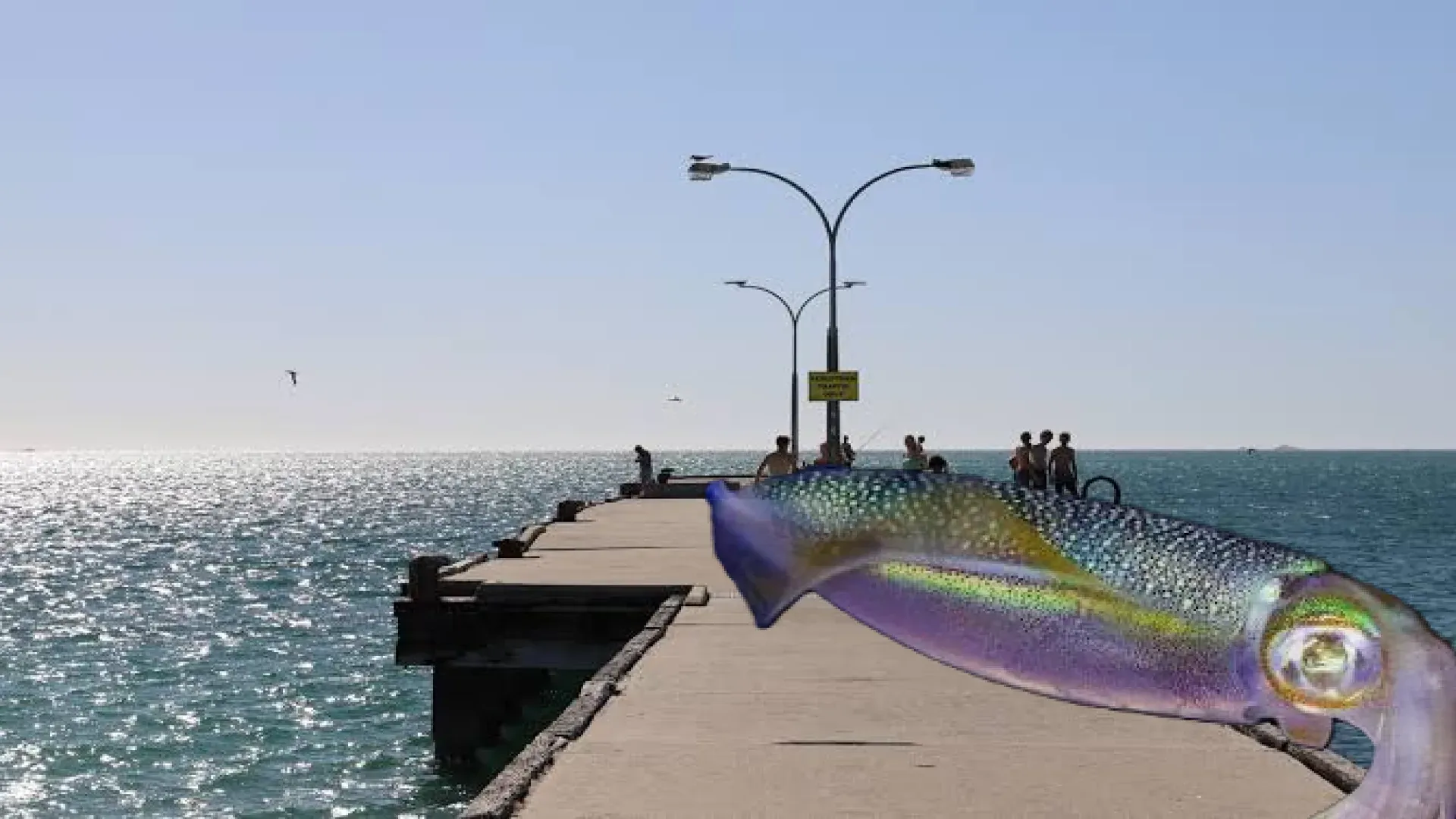
Target Species
Southern Calamari
Woodmans Point is one of the best spots for southern calamari fishing in Perth, with seagrass edges close to shore, sheltered water and squid all year. Cast size 2.5 to 3.0 egi jigs along the line where weed meets sand at dawn or dusk, ideally on the last of the incoming tide, from the groynes or a kayak launched at the boat ramp.
Ammo Jetty closed for rebuild (expected late 2027)
The Woodman Point Ammo Jetty is closed for replacement. The Department of Transport scheduled construction to start in November 2026 and expects it to take about 12 months, with parts of John Graham Reserve closed until late 2027. No exact reopening date has been announced. The Woodman Point Groyne isn’t part of the closure (the department lists it as an alternative spot), and the boat ramp isn’t among the listed closures, so the land-based tactics in this guide work from the groynes and shoreline. Dates can shift, so check the Department of Transport’s Ammo Jetty project page for the latest status before you go.
Jutting into the northern end of Cockburn Sound just south of Fremantle, Woodmans Point (officially Woodman Point) is one of Perth’s favourite squid spots. The headland pushes out into the sound past patches of Posidonia and Amphibolis seagrass. Those meadows are nursery and feeding grounds for southern calamari (Sepioteuthis australis). Whether you are casting egi jigs from the sandy points and rock groynes or launching a kayak into the lee of the point, you are positioning yourself right over prime hunting grounds.
What sets Woodmans Point apart is its position at the northern end of Cockburn Sound, sheltered from the open ocean swell by Garden Island and Carnac Island. In calm, settled weather the water runs very clear, which suits squid that hunt by sight, ambushing baitfish and small prawns. In this guide, you will learn the underwater layout of the area, learn how to read tidal movements across the flats, and discover the exact technical approaches required to tempt cautious calamari across changing seasons.
Getting There
Southern Calamari
Sepioteuthis australis
Always check current NSW DPI regulations before fishing. Bag and size limits may change.
Understanding Woodmans Point: Location Intelligence
Woodmans Point sits between Cockburn Sound and Owen Anchorage, where beds of Posidonia seagrass meet shallow sand channels in two to eight metres of water. That mix of weed cover and clean sand gutters gives southern calamari ideal cover to ambush baitfish and shrimp.
To fish Woodmans Point successfully, an angler must develop an eye for coastal bathymetry and marine flora. The seabed extending westward and southward from the prominent point is not a uniform sandy plain; instead, it consists of a mosaic of marine habitats. Cockburn Sound has lost much of its original seagrass since the 1960s, which makes the meadows that remain around Woodmans Point all the more important. These ribbon-like beds of Posidonia australis and Amphibolis antarctica trap nutrients, provide shelter for countless marine invertebrates, and house enormous schools of hardyheads, blue sprats, and juvenile sea mullet. Southern calamari, with large eyes and rapid jet propulsion, hover just above the weed canopy waiting to launch forward with their twin feeding tentacles.
The underwater architecture around Woodmans Point transitions through several distinct zones. Near the shoreline and alongside the engineered breakwalls and groynes, water depths start at one to two metres over broken sand pockets and limestone rubble. Moving outward past the twenty-metre mark from shore, the depth steps down into three to five metres, where dense weed canopies dominate. Further out into the sound, depths plateau between seven and ten metres, forming deep channels that funnel tidal water between Garden Island and the mainland. Calamari navigate these distinct depth contours based on sunlight penetration, water clarity, and tidal pressure.
Crucially, local squidders must pay attention to bottom transitions. The boundary line where lush green ribbon weed terminates and white sand begins is often called the edge. Calamari rarely hunt deep inside thick, impenetrable weed where their tentacles can become tangled. Instead, they patrol directly along these sandy edges, hovering motionless in the green water column while looking out across the open sand gutters. When schools of whitebait or school prawns drift through the sand clears, calamari strike from above with explosive speed. Spotting these sand-and-weed transitions with polarised sunglasses is the most valuable skill you can possess when hunting them from shore, kayak, or small dinghy around the headland.
Current dynamics around the point also play a major role in feeding behaviour. Because Woodmans Point juts significantly into Cockburn Sound, even moderate tidal shifts of half a metre create noticeable current seams along the outer drop-offs and around the tips of the rock groynes. Rather than fighting strong currents, calamari seek shelter in the soft eddies created on the down-current side of sand bars, weed banks, and man-made structures. The influx of clean ocean water running along the sound pushes schools of pilchards, garfish, and herring through these zones, sparking competitive feeding flurries among resident calamari packs.
Location Essentials
Woodmans Point
-32.1310, 115.7540
For decades, the old timber Ammunition Jetty (the Ammo Jetty) was the best-known land-based squid platform in Cockburn Sound. Built in 1903 for loading explosives and opened to the public in 1984, the jetty has reached the end of its life, and the Department of Transport is replacing it with a new Ammo Jetty. Construction was scheduled to start in November 2026 and is expected to take about 12 months, with no exact reopening date announced yet. There is no access to the jetty during the works, the water immediately around and under it is off limits, and parts of John Graham Reserve, including beach access along the shore past the jetty, are expected to stay closed until late 2027. The Woodman Point Groyne and the rest of the point outside the fenced areas are not part of the closure.
With the jetty off limits, land-based anglers have moved to the ground around it. The boat ramp groynes, the shoreline running north toward Coogee Beach, and the sandy points outside the fenced work zone all reach the same weed edges. Anglers with kayaks or small dinghies launched from the Woodman Point boat ramp have the edge, because they can drift the weed flats a short paddle offshore. Knowing how to target these natural weed beds without relying on jetty pylons will ensure consistent catches throughout the year.
When Is the Best Time to Fish for Southern Calamari at Woodmans Point?
The best time to fish for Southern Calamari at Woodmans Point is during the low-light windows of dawn and dusk, especially when an incoming tide coincides with light easterly winds. Night sessions are also productive around lit water, where calamari hunt small baitfish drawn to the illumination.
Southern calamari are sight hunters, and their large eyes give them an edge during twilight periods when light levels drop rapidly. At dawn, squid begin actively hunting across the tops of the Posidonia seagrass meadows, ambushing school fish and crustaceans that are shifting away from their night shelters. The hour immediately preceding sunrise and the first sixty minutes of daylight consistently yield aggressive strikes, as squid take full advantage of their superior low-light vision before the sun penetrates deep into the water column.
Dusk provides an equally frantic bite window. As the sun dips below the Indian Ocean horizon, baitfish such as hardyheads, blue sprats, and small garfish lose their defensive schooling formations. Calamari move up out of the deeper channels between Woodmans Point and Garden Island, hunting the shallower flats and groyne drop-offs. Working a squid jig through the upper third of the water column during this twilight changeover often results in savage takes, as hungry cephalopods intercept silhouettes against the fading western sky.
Night fishing brings another dynamic altogether. While calamari will cruise the shallow flats under the cover of darkness, artificial lighting acts as a massive feeding magnet. With the Ammo Jetty closed, look for other lit water, such as the boat ramp area or a lantern of your own, which pulls baitfish to the surface. Squid hold just beyond the edge of the light, sitting in the ambient shadows where they can dart in and ambush unwary prey. Bright moonlit nights also let squid hunt the open weed flats away from shore lights.
Tidal movement plays a fundamental role in squid behaviour in Cockburn Sound. While the tidal range around Fremantle and Woodmans Point rarely exceeds one metre, water movement governs both water clarity and bait dispersal. A rising tide brings clean, cool ocean water straight into the sound, clearing out suspended sediment and providing the gin-clear conditions calamari prefer. Conversely, strong tidal flow can make it difficult to keep a light egi jig hovering in the strike zone. The ideal scenario is the last two hours of the incoming tide through to high slack water, where clarity is at its absolute peak and current flow eases enough to allow a slow, natural jig sink rate.
Wind direction dictates session quality more than many anglers realise. The prevailing summer sea breeze, known locally as the Fremantle Doctor, blows hard from the south-west in the afternoons, kicking up chop and disturbing bottom silt. Target early mornings when gentle easterly land breezes flatten the sea surface to glass, or fish sheltered pockets along the northern lee of the point during southerly blows.
Southern Calamari Seasonal Calendar
Tide Times
Optimal Tide
Last two hours of incoming tide through to high slack water
Tide movement is critical for fish activity. Most species feed actively during tide changes, especially the run-in (incoming) tide.
Detailed hourly tide charts
Official tide predictions
7-day tide calendar
Tide Guide
Best for most species. Fish move in to feed as water rises.
Good for ambush predators. Baitfish get swept out.
Slower bite. Fish less active during slack water.
New/full moon. Bigger tidal range, more fish movement.
Moon Phase & Solunar
Moon phases influence fish feeding behavior. New and full moons create spring tides with stronger currents and increased fish activity.
Best Phases
- New Moon: Peak feeding activity, spring tides, excellent fishing
- Full Moon: Strong tides, night feeding, great for nocturnal species
- 3 Days Either Side: Extended peak period for maximum results
Major/Minor Periods
- Major Periods: Moon overhead/underfoot (2-3 hours)
- Minor Periods: Moon rise/set (1-2 hours)
- Best Times: Major period + dawn/dusk = explosive action
Weather Conditions
Check current conditions before heading out. Wind, swell, and barometric pressure significantly affect fish behavior.
Official forecasts, warnings & radar
Hourly wind speed & direction
Swell height, period & direction
Read the Water Line at High Tide
Aim your casts directly along the distinct colour boundary where dark green Posidonia seagrass meets white sand ribbons. Calamari almost always cruise parallel to this contrast edge, facing into the light current to ambush passing baitfish.
What Tackle Do You Need for Southern Calamari at Woodmans Point?
You need a specialised 8-foot to 8-foot 6-inch light egi rod rated for PE 0.4 to 0.8 line, paired with a 2500-size spinning reel spooled with 8 to 12-pound braided line and a 6 to 10-pound fluorocarbon leader. This balanced setup provides the parabolic flex required to prevent tearing fragile squid tentacles.
Targeting Southern Calamari requires tackle tailored specifically to the delicate anatomy and darting fight of cephalopods. Standard stiff graphite spin sticks designed for bream or flathead often pull barbs straight out of a squid’s tender feeding arms. A proper egi rod features a soft, forgiving tip section that blends smoothly into a parabolic mid-section. This unique taper absorbs the powerful, pulsating jet contractions of a hooked squid, keeping constant tension on the barbless crown without ripping through the flesh. The length, typically between 8 feet and 8 feet 6 inches, gives you the casting distance needed to reach distant sand holes from rock groynes and high platform vantages.
Your reel choice should focus on weight and drag smoothness rather than raw stopping power. A 2000 to 2500-size spinning reel offers the perfect balance on a lightweight egi blank. It is essential that the drag system starts smoothly with zero initial stickiness. Calamari pump backward in sudden, violent bursts; any hesitation in drag release will instantly tear the tentacles away from the jig. Setting your drag surprisingly light, just tight enough to prevent slippage during a sharp whip retrieve, is the secret to staying pinned. For more tackle basics, see our tackle essentials guide.
Spooling with ultra-thin, smooth braid is mandatory for modern egi techniques. An 8-carrier PE 0.6 or PE 0.8 line cuts through the wind and water with minimal belly, giving you direct contact with your jig. This thin diameter lets you feel subtle takes on the drop, such as a gentle weightlessness or a tiny tap, which you would never detect on heavy mono. Combine this with a 1.5 to 2-metre leader of premium Japanese fluorocarbon testing between 6 and 10 pounds. Fluorocarbon sinks rapidly, resists abrasive contact with limestone reef and sharp mussel shells, and remains virtually invisible in the crystalline water of Cockburn Sound.
Southern Calamari Tackle Specifications
| Component | Specification |
|---|---|
| Rod | 8'0" to 8'6" light egi rod, Egi weight 2.5-3.5, PE 0.4-0.8 rating |
| Reel | 2000-2500 size high-performance spin reel with ultra-smooth drag |
| Main Line | PE 0.6 to PE 0.8 (8-12lb) 8-carrier braided line |
| Leader | 6-10lb 100% fluorocarbon, 1.5 to 2.0 metres in length |
| Line Connection | FG Knot, PR Knot, or back-to-back Uni Knot |
| Terminal Clip | Size 00 to 0 Egi Snap or lightweight fast-lock clip |
| Primary Lures | Japanese squid jigs (Egi) in sizes 2.5, 3.0, and 3.5 |
| Landing Gear | Telescopic landing net with fine rubber mesh or an egi gaff |
How Do You Rig for Southern Calamari?
Rig for Southern Calamari by joining a 1.5 to 2-metre fluorocarbon leader to your main braid with an FG or double uni knot, then terminating with a specialised egi snap tied via a perfection loop or unit knot directly onto the squid jig. This direct connection preserves the natural sinking angle and side-to-side darting action of the lure.
Rigging for squid demands minimalism and balance. Every extra swivel, split ring, or sinker added to the line interferes with the hydrodynamics of the egi jig, which is precisely ballasted from the factory to fall at a natural 45-degree angle. Adding unwanted weight causes the jig to nosedive directly into bottom weed, snagging the crowns and ruining the presentation.
Start your rigging by connecting your micro-braid mainline to the fluorocarbon leader. Because thin PE braid can slip through traditional monofilament joins, the FG knot is the gold standard connection here. It creates an ultra-slim profile that flows through the small guide train of an egi rod without clicking or catching during aggressive whip-casts. If tying an FG knot on a wind-swept groyne proves tricky, an 8-turn back-to-back Uni knot or a Modified Albright provides a reliable field-tied alternative. For detailed knot instructions, review our guide to fishing knots.
At the business end, avoid tying directly to the eye of the squid jig. Instead, attach a dedicated, round-bend egi snap. These micro clips allow you to swap jig sizes, sink rates, and colours in seconds without repeatedly trimming your fluorocarbon leader. Furthermore, the rounded profile of the snap gives the jig total freedom of movement, maximising the erratic side-to-side darting motion triggered by upward rod snaps.
When fishing deeper water off boats, kayaks, or high drop-offs subject to brisk tidal push, you can adapt your rig without losing lure action. An adjustable chin weight or specialized clip-on nose weight can be added directly to the nose of a size 3.5 jig to increase sink speed through the current. Alternatively, bait anglers targeting squid from stationary platforms often employ a sliding float rig. This system suspends a whole silver whiting or garfish rigged on a dual-crown squid spike beneath a weighted pencil float, allowing the bait to drift naturally over the weed canopy without snagging bottom debris. To explore more rigging arrangements, read our guide to fishing rigs.
Rigging a Precision Egi Leader System
- 1
Inspect and Strip the Mainline
Cut away the last half-metre of PE braid to eliminate any line wear, wind knots, or fraying from previous sessions before starting your connection.
- 2
Measure Your Fluorocarbon Leader
Pull off approximately 1.5 to 2 metres of supple 8-pound Japanese fluorocarbon. This length provides plenty of abrasion resistance while keeping the knot outside the reel spool on a cast.
- 3
Tie the Line-to-Line Connection
Join the PE braid to the fluorocarbon using a slim FG knot with 20 alternating half-hitches, or tie a neat 7-wrap back-to-back Uni knot. Moisten with saliva before cinching tight.
- 4
Test Connection Under Tension
Firmly pull both ends in opposite directions with gloved hands to ensure the braid bites deeply into the fluorocarbon sheath without slipping under heavy loads.
- 5
Trim Tag Ends Flush
Use micro-serrated braid scissors to trim the leader and braid tags flush against the knot wraps, preventing guide friction during long casts.
- 6
Attach the Egi Snap
Tie a high-grade size 0 or 00 egi clip to the end of your leader using a 5-wrap Uni knot or an improved Clinch knot, ensuring the knot seats squarely against the snap loop.
- 7
Clip and Balance the Jig
Snap on your selected squid jig. Hold the leader suspended by hand to confirm the jig hangs with a horizontal to slight nose-down attitude without twisting.
What Bait Works Best for Southern Calamari?
The best lures for Southern Calamari at Woodmans Point are Japanese cloth-wrapped squid jigs (Egi) in sizes 2.5 to 3.5, while whole fresh garfish or whiting pinned to a tandem squid spike represent the most deadly natural bait options.
While modern egi lures dominate calamari angling, natural baits remain devastatingly effective, particularly during night sessions or when squid are wary after heavy fishing pressure. Southern Calamari hunt by sight and vibration, but their chemoreceptors quickly identify natural oils in the water, compelling them to latch on and refuse to let go.
Natural bait presentation centers around the tandem squid prong or bait spike. This rig features a long stainless-steel skewer tipped with twin rows of upward-facing, needle-sharp barbs. The skewer is pushed lengthways through the baitfish from the tail and emerges out of the mouth, securing the offering in a natural, straight swimming posture. Small yellowfin whiting, blue sprats, pilchards, and fresh southern sea garfish are unmatched options. Garfish in particular provide an irresistible combination of glittering silver scales, tough skin that stays on the spike, and a slender silhouette that squid can wrap their tentacles around effortlessly.
When it comes to artificial jigs, matching cloth colour and base foil to water clarity and ambient light is critical. In the clear coastal waters of Cockburn Sound, natural colours replicating local forage consistently outperform wild neon shades during daylight hours. Olive green, soft brown, sand, and translucent prawn patterns on gold, marble, or clear bodies look natural over Posidonia weed. On overcast days, during dusk, or after dark, shift toward high-contrast pinks, vibrant oranges, and jigs featuring UV-reactive Keimura cloth or 490nm glow bases that light up like deep-water bioluminescence. For more advice on food sources across species, visit our fishing bait guide.
Calamari Bait and Jig Performance Comparison
| Egi Squid Jigs (Cloth-Wrapped) | Fresh Southern Garfish | Whole Silver Whiting | |
|---|---|---|---|
| Effectiveness Rating | Exceptional (Active Casting) | Exceptional (Drift & Float) | High (Drift & Float) |
| Durability on Hook | Very High (Dozens of squid per jig) | Moderate (Lasts 1 to 3 squid strikes) | High (Firm flesh stays secure on spike) |
| Scent Dispersion | None (Unless scented spray applied) | High (Natural oils and scale shimmer) | Moderate (Subtle natural fish scent) |
| Availability | Readily available in all tackle stores | Catch your own or buy frozen at tackle shops | Easy to catch locally or purchase fresh |
| Best Use Conditions | Daytime sight casting, clear water, and active drift sessions | Suspended under a float during night sessions or heavy chop | Anchored boat sessions and slow drifting along weed lines |
Apply Natural Squid Scents to Artificial Jigs
When squid follow your jig right to your feet without striking, coat the cloth flanks of your egi lure with a dedicated amino-acid or pilchard-based squid scent. The added scent trail gives tentative calamari the sensory confirmation they need to fully commit to the attack.
What Egi Jig Size and Colour Should You Use at Woodmans Point?
Use a size 2.5 egi in shallow water under two metres or when squid are small, a size 3.0 as your all-round jig over two to five metres of weed, and a size 3.5 for deeper drifts, wind, current, and bigger winter squid. Pick natural colours like olive, brown and orange on gold or marble bases in clear daylight, and pink, orange or glow jigs at dawn, dusk and after dark.
Calamari fishing at Woodmans Point comes down to jig choice. Size controls how fast the jig sinks and how deep it fishes, and colour controls whether a following squid commits. Carry at least two sizes and a light and dark colour in each, and swap until you find what the squid want on the day.
Sink rate is the key number. Most jigs are printed with it, in seconds per metre. Over the shallow weed close to the groynes, a slow-sinking 2.5 or a shallow-version 3.0 stays above the weed tips for longer. Off the point and from a drifting kayak, a standard 3.0 or 3.5 gets down before the wind and current drag it away. If you keep catching weed, go up a size in slower-sinking models or stop the drop sooner. If the jig never reaches the edge of the weed, go heavier or clip on a small nose weight.
The retrieve changes with the conditions. On calm, clear days, two or three sharp snaps followed by a long, slow glide works best, because squid can see the jig from a distance and like to inspect it. In wind chop or dirty water, shorten the glide and add an extra snap so the jig stays in front of them. If squid follow but won’t grab, stop working the jig altogether and let it sit just above the weed for five to ten seconds.
Egi Jig Selection for Woodmans Point Calamari
| Size 2.5 | Size 3.0 | Size 3.5 | |
|---|---|---|---|
| Best Depth | 1 to 2 metres | 2 to 5 metres | 4 metres and deeper |
| Typical Sink Rate | Slow, around 4 to 6 sec/m | About 3 to 3.5 sec/m | Faster, around 3 sec/m or less |
| Conditions | Shallow weed near the groynes, small squid, calm days | All-round choice from shore or kayak | Deeper drifts, wind, current, bigger winter squid |
| Retrieve | Short snaps, long glide just over the weed | Two or three snaps, then a slow glide | Bigger lifts, shorter glides in chop |
| Best Colours | Natural olive, brown and clear in daylight | Orange or brown on gold by day, pink at dusk | Dark or red-base jigs in dull light, glow at night |
Match the Base Foil to the Light
The colour under the cloth matters as much as the cloth. Gold and marble foils flash in bright sun, red bases show up as a dark silhouette in dull light, and glow or UV bases stand out at dawn, dusk and night. Change the base before you change the size.
How Do You Catch Southern Calamari at Woodmans Point?
Catching Southern Calamari at Woodmans Point relies on an active egi retrieve that mimics an injured prawn darting off the seabed, followed by a slow, enticing sink directly over sand patches and seagrass borders.
Working an egi lure effectively is fundamentally different from standard lure casting for finfish. Calamari hunt predominantly by sight, ambushing their prey from beneath weed canopies or behind calcified limestone outcroppings. Success comes down to mastering lure sink rate, disciplined depth control, and reading the subtle takes of feeding cephalopods. To expand your casting repertoires across different aquatic systems, explore our guide on fishing techniques.
Casting Strategy and Bait Placement
When fishing from the Woodman Point groynes, the Coogee Beach jetty to the north, or an anchored runabout drifting inside Cockburn Sound, always cast downwind or across the prevailing breeze. Light fluorocarbon leaders and featherweight jigs catch the wind quickly, which can blow massive bows of slack line onto the water and drag the lure unnaturally through the water column.
Aim your casts toward visible transition zones. Look for light sandy patches surrounded by dark Posidonia or Amphibolis weed beds. These sand potholes serve as killing fields where calamari gather to ambush garfish, hardyheads, and prawns. Once your jig hits the surface, flip the bail arm over manually and count the sink rate down. Standard size 3.0 jigs fall at roughly three to 3.5 seconds per metre. In four metres of water, allow a ten to twelve second drop so the jig hovers just inches above the weed tips. Let the jig touch down lightly, but do not let it foul on the bottom weeds.
Bite Detection and Hookset
Calamari do not strike a lure like a tailor or Australian salmon. When a squid attacks, it extends two long feeding tentacles to grab the lure, then pulls it in toward its beak with eight shorter arms. Because of this, bites can feel remarkably faint.
Most bites occur entirely on the pause while the jig sinks naturally. You will rarely feel an aggressive jerk through the graphite blank. Instead, watch your braided line where it enters the water. Look for:
- A sudden straightening or tick in the line as a squid grabs the lure on the drop.
- The line going completely slack prematurely, signalling a squid has seized the jig midwater and pushed it upward.
- A sensation of dead weight or gentle weed drag when you sweep the rod tip upward to begin your next hop.
When you notice that weight, never strike aggressively as you would when setting a suicide hook on a snapper. An aggressive strike will rip the fragile, barbless crown hooks right out of the soft squid tentacles. Instead, execute a firm, sweeping lift of the rod. Wind the reel handle continuously to establish tension. Once the flexible egi rod bends into its parabolic curve, maintain smooth pressure.
Put together, the basic egi routine is: cast across the current over a sand-and-weed edge, let the jig sink to about 30 centimetres above the seagrass, give it two or three sharp upward snaps, then let it glide back down on a semi-slack line while you watch the braid for ticks. When you feel weight, lift smoothly and keep winding.
Fighting and Landing Strategies
Fighting a Southern Calamari is an exercise in steady tension. Calamari propel themselves backward in powerful pulses by forcing water through their syphon. When a large calamari jets away, let your light drag yield line smoothly without thumbing the spool. Pumping and dropping the rod tip creates momentary slack, which allows the barbless crown hooks to fall free instantly. Keep the rod arched high at a 45-degree angle and wind steadily through every pulse.
As you draw the squid closer to the rocks, the groyne, or the boat gunwale, prepare for its defensive ink release. A frightened calamari will discharge several thick clouds of dark ink to blind predators.
- Keep the squid in the water alongside the landing zone for thirty to sixty seconds, letting it purge its syphon reservoir completely.
- Never lift a large squid out of the water directly over your clothes or into the boat until it has blown its ink.
- Slide a landing net under the mantle from behind rather than approaching the head and tentacles, which causes the squid to jet away in panic.
- If fishing from higher rock ledges, employ a squid gaff or long-handled net to hoist the catch safely.
Once the squid is safely landed, dispatch it humanely using a specialised squid spike (iki jime tool) inserted between the eyes. You will see the entire body turn instantly translucent white, confirming an immediate, humane kill. This process also halts further ink production, relaxes the muscle fibres, and preserves the sweet, tender eating quality of fresh calamari.
What Are the Rules for Fishing at Woodmans Point?
Southern calamari at Woodmans Point have no minimum size, and you can take 15 squid, cuttlefish and octopus combined per person per day (30 per boat with two or more licensed fishers). You need a Recreational Fishing from Boat Licence to fish from a powered boat, and the Ammo Jetty is closed for rebuilding.
Understanding local fishery regulations protects Cockburn Sound’s valuable cephalopod stocks and keeps recreational access open for everyone. Squid can be taken year-round, but the jetty closure changes where you can fish from. For complete state policies, examine our fishing safety recommendations alongside our guide on fishing regulations.
Critical Safety and Site Access Warnings
- Ammo Jetty Closure: The Woodman Point Ammo Jetty is closed to the public while it is replaced, along with the water immediately around and under it. Once the new jetty opens, the area right around it will stay closed to motorised vessels to protect divers and snorkellers. Do not cross fences or fish inside the work zone.
- Rock Safety: Groynes and breakwalls surrounding Woodman Point feature uneven, wet, and weed-coated limestone. Wind chop on a strong Fremantle Doctor can wash over the lower rocks. Wear grippy footwear and fish with a mate.
- Ink and Beak: Squid ink stains clothing, boat decks and concrete. Southern calamari also have a sharp, parrot-like beak at the centre of their arms that can give a painful bite.
State Regulations for Southern Calamari
Southern calamari fall under DPIRD’s squid group rules in Western Australia:
- Bag Limit: 15 squid, cuttlefish and octopus combined per person per day.
- Boat Limit: 30 squid, cuttlefish and octopus combined on a boat with two or more licensed fishers. On a powered boat, each of those fishers needs their own licence.
- Size Limit: No minimum size applies to squid.
- Licences: No licence is needed to jig squid from the shore or from a kayak or other non-powered craft, but you need a Recreational Fishing from Boat Licence (RFBL) to fish from a powered boat, including squid jigging.
These limits were verified on 17 November 2026 against the official DPIRD squid rules. Rules change between seasons, so confirm them on the DPIRD Recreational Fishing Rules page before you head out.
Conservation and Ethical Practices
Calamari are fast-growing, short-lived and an important food for pink snapper, mulloway, dolphins and seabirds, so the squid you leave behind feed the fish you’ll chase later in our North Mole pink snapper guide and Swan River mulloway guide. Follow these ethical angling guidelines:
- Take only what you need for an immediate fresh meal. Squid flesh freezes well, but local populations thrive best when recreational pressure remains conservative.
- Despatch catches immediately using an egi spike tool to guarantee rapid, humane dispatch.
- Never leave discarded fluorocarbon leader, broken jig prongs, or plastic bait packets on the rocks or around boat ramps. Discarded line kills seabirds and other marine life.
- If catching juvenile calamari with mantles smaller than fifteen centimetres, release them gently without lifting them onto dry, abrasive stone or hot sand.
- Wash down rocks or public jetty decking with a bucket of seawater if your catch discharges ink across shared walking paths.
Your Questions About Southern Calamari Fishing at Woodmans Point
What is the best time to fish at Woodmans Point?
The best time to target Southern Calamari at Woodmans Point is during the first light dawn window and the evening twilight change of light, particularly when paired with a rising high tide.
Dusk and dawn represent peak fishing hours because predatory calamari use the reduced light to ambush unsuspecting baitfish along weed bed edges. Midday fishing can be effective if the water remains gin-clear and the sea breeze is calm, but the two hours surrounding sunrise and sunset offer the most consistent land-based and boat action.
Is Woodmans Point suitable for beginners?
Yes, Woodmans Point is an accessible location for beginner anglers because squid jigging requires minimal technical gear and no messy live baits.
Beginner friendly squidding is easy to pick up because modern cloth-wrapped egi jigs provide all the built-in action you need. Novice anglers can practice casting and retrieving from the sandy beach edges or safe sections of the groynes, making it an easy fishing spot to learn how to detect squid pulls.
Do I need a boat to fish at Woodmans Point?
No, you do not need a boat to catch calamari at Woodmans Point, as substantial seagrass beds run close enough to shore to reward land-based anglers.
While having a dinghy, kayak, or runabout allows you to drift through deeper beds across Cockburn Sound, shore fishing from the Woodman Point groynes, nearby marina walls, or the adjacent Coogee shoreline regularly produces good bags of calamari.
Where are the best specific spots at Woodmans Point?
The most productive spots are the rock groynes beside the boat ramp, the weed edges off the point outside the jetty work zone, and the weed banks north toward Coogee.
These marks all have Posidonia seagrass broken up by white sand patches. With the Ammo Jetty closed for reconstruction, they are the best options for land-based squidders.
What size Southern Calamari can I expect?
Most calamari caught around Woodmans Point have hoods of 20 to 30 centimetres.
During the cooler winter and early spring months, the average catch size increases noticeably. Anglers drifting the deeper weed lines in the cooler months have a chance at a trophy squid with a hood over 35 centimetres.
Is there parking available at Woodmans Point?
Yes, there is sealed parking at the Woodman Point boat ramp and around John Graham Reserve, off Cockburn Road.
Access is via Woodman Point View, with bays for both boat trailers and cars. During peak summer weekends and prime squid seasons, these parking bays fill rapidly before first light, so plan to arrive early to secure a convenient space.
Can I fish at night at Woodmans Point?
Yes, night fishing is highly productive for Southern Calamari because squid feed actively under the cover of darkness.
After dark, calamari rise from deeper weed beds into shallow flats to hunt shrimp and baitfish. Employing glow-in-the-dark or UV-reactive jigs charged with a torch will significantly boost your catch rates during night squidding sessions along the shoreline.
Where can I buy bait near Woodmans Point?
You can buy squid jigs, bait and tackle at the tackle shops in nearby Fremantle, Spearwood and Rockingham.
Local tackle shops stock egi jigs, frozen garfish and whiting, and squid spikes. Some service stations carry frozen bait for early starts.
What are the current bag and size limits?
Southern calamari have no minimum size, and the daily bag limit is 15 squid, cuttlefish and octopus combined per person, with a boat limit of 30.
Check the DPIRD rules lookup before each trip, and take only what you’ll eat fresh.
Is Woodmans Point family-friendly for fishing?
Yes, the sandy beaches and grassy park reserves at Woodmans Point provide a safe, family-friendly environment for fishing with children.
The shoreline offers gentle beach access, toilets and grassy picnic areas, making it a good spot to take kids squidding when the sea is calm. Keep them clear of the fenced jetty work zone.
What should I bring for a fishing session?
Bring an 8-foot light spin rod, size 2.5 and 3.0 squid jigs, a bucket, an egi spike tool, a small net, and sun protection.
Your essential gear checklist should also include polarised sunglasses to spot squid following your lure, a UV charging torch for low-light sessions, a fluorocarbon leader spool, and a rag to wipe away any stray squid ink discharged during landing.
How crowded does Woodmans Point get?
Woodmans Point can get very crowded on calm weekends and public holidays.
The boat ramp is one of the busiest in Perth, so the groynes see plenty of foot traffic. The best times to avoid crowds are midweek mornings, overcast winter days, or early dawn hours before family day-trippers arrive at the foreshore reserves.
Latest Fishing Reports
Stay updated with the latest catches, conditions, and hot tips from Woodmans Point. Check these sources for recent reports filtered by location and species.
Fishraider
Community fishing reports and catch logs
Fishing World
Professional fishing reports and news
Tackle World
Local tackle shop reports and tips
NSW DPI
Official recreational fishing reports
Fishingmonthly
Monthly fishing magazine and reports
Hooked Up
Video fishing reports and tips
Pro Tip: Filter Reports
When browsing reports, search for "Woodmans Point" or nearby landmarks. Look for reports from the last 7-14 days for the most relevant information. Pay attention to tide times, weather conditions, and successful techniques mentioned.
Share Your Catch
Caught something at Woodmans Point? Share your success with the community! Upload your catch photos and reports to help other anglers.
Fishing regulations, bag limits, and marine sanctuary boundaries change periodically across Western Australia. Anglers should consult the Department of Primary Industries and Regional Development (DPIRD) website and verify local signage before wetting a line.
Squid make great bait for other Perth targets: try a strip of fresh calamari on the Perth metro herring a whole one for Swan River chopper tailor, or rig one up for the big samsonfish at Two Rocks Marina. Explore more fishing spots, browse our species guides, or brush up with the fishing basics guide.
Quick Info
- Location
- Woodmans Point
- Region
- Cockburn Sound, WA
- Coordinates
- -32.1310, 115.7540
- Difficulty
- intermediate
- Target Species
- Southern Calamari
Conditions
Check local weather and tide conditions before heading out.